
KEY
POINTS
- Add-backs are not a strategy. They are a correction used to show normalized earnings under arm’s-length conditions.
- Only well-documented, defensible add-backs tend to survive a buyer’s Quality of Earnings review.
- Owner compensation, recurring “one-time” costs, and unsupported adjustments are frequent points of challenge.
- When add-backs are rejected in diligence, valuation can fall quickly and buyer skepticism expands beyond the adjustment schedule.
- A conservative, pre-documented add-back schedule strengthens credibility and protects negotiating leverage.
Every business owner who has spent time thinking about selling has heard some version of the same advice: add back your personal expenses, normalize your compensation, and your EBITDA will look stronger to buyers.
That advice is not wrong. But it is incomplete. And the gap between what sellers think their add-backs are worth and what buyers are actually willing to accept is one of the most expensive surprises in the exit process.
Add-backs are not a strategy. They are a correction. Their purpose is to show what a business earns under normal, arm’s-length operating conditions, not to manufacture a number that is not there. Buyers understand the difference. Their advisors are paid to find it.
What Add-Backs Are Actually For
The logic behind add-backs is straightforward. When a buyer looks at your EBITDA, they want to understand what the business would earn under new ownership. Some expenses on your books exist because of how you personally run the business and they won’t continue once you exit. Removing those expenses gives a more accurate picture of the true earnings power of the business.
Legitimate add-backs generally fall into a few categories:
- Above-market owner compensation. If you pay yourself $450,000 but a qualified replacement CEO would cost $225,000, the difference is a defensible add-back. You are normalizing compensation to reflect arm’s-length conditions.
- Genuine one-time expenses. A legal settlement. A non-recurring consulting engagement. A one-time equipment repair. Costs that are real but will not repeat under new ownership are generally accepted with the right documentation.
- Personal expenses run through the business. Personal travel, vehicles used for non-business purposes, meals and entertainment that are personal in nature. When clearly categorized and documented, these add back cleanly.
The keyword across all of these is defensible. Every add-back you put on your schedule will be evaluated by a buyer’s advisory team. The ones that hold up are the ones you can explain simply and support with documentation. The ones that do not hold up become negotiating leverage for the buyer.
What Buyers Challenge and Why
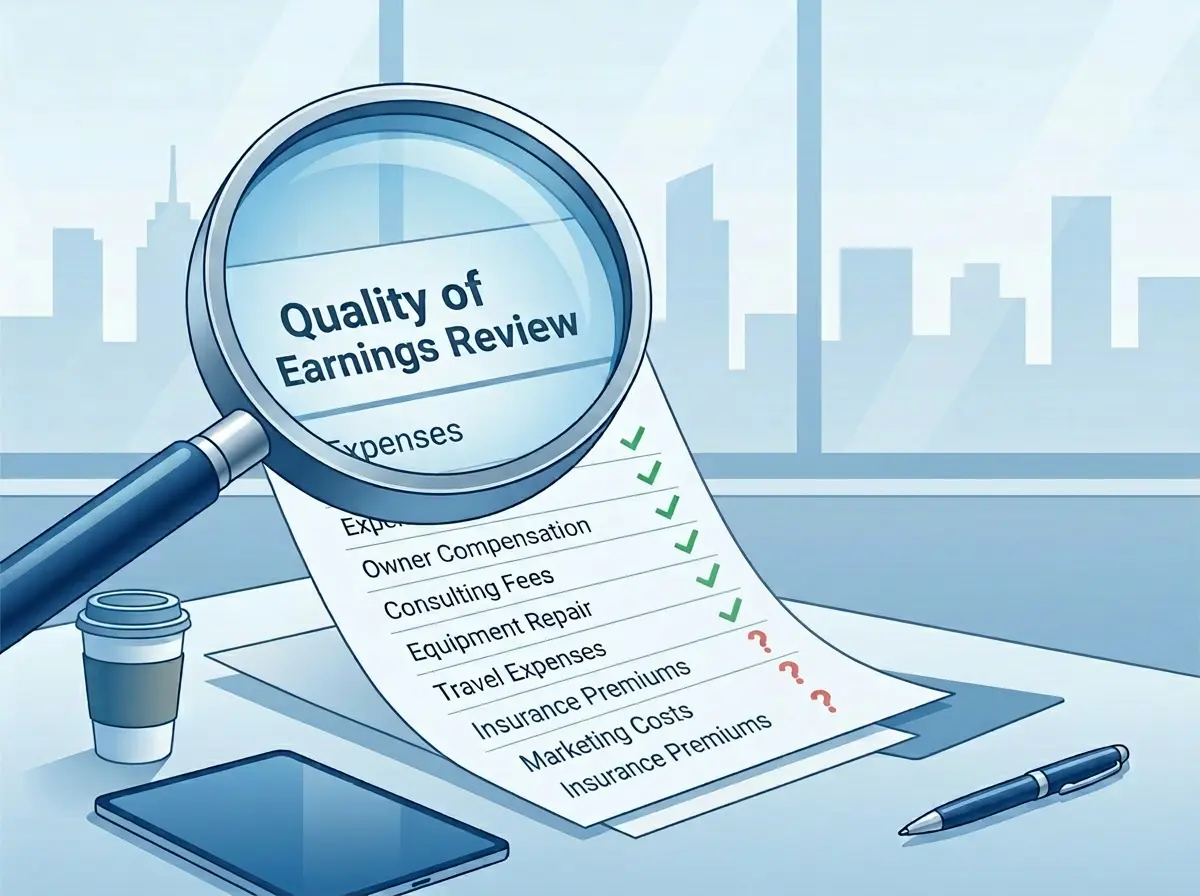
A Quality of Earnings (Q of E) analysis is the buyer’s primary tool for stress-testing your financials. It is a detailed, line-by-line review of your revenue, expenses, and any adjustments you are claiming. The advisors conducting this analysis have seen every version of the add-back conversation and they are skeptical by nature.
Learn more about the due diligence process and how to improve your outcomes here: https://southcoastfp.com/how-to-survive-due-diligence-without-breaking-a-sweat/
Here is what gets challenged most often.
Owner compensation add-backs that do not reflect reality. The add-back only holds if the replacement cost you are claiming is genuinely market-rate for the role. If you run a complex, multi-location business and claim your replacement would cost $150,000, a buyer’s team will push back with data. The add-back will be reduced to a number they can defend, not the number you proposed.
One-time expenses that recur. If your books show a “non-recurring” equipment expense in three of the last four years, a buyer is not going to treat it as non-recurring. Anything that appears with any regularity will be treated as an operating cost. This is one of the most common areas where sellers overestimate their normalized EBITDA.
Revenue that has already ended. Some sellers attempt to add back the earnings from a customer or contract that was lost, framing it as a non-recurring reduction. Buyers will evaluate whether that revenue was genuinely one-time and they will look at what replaced it, if anything.
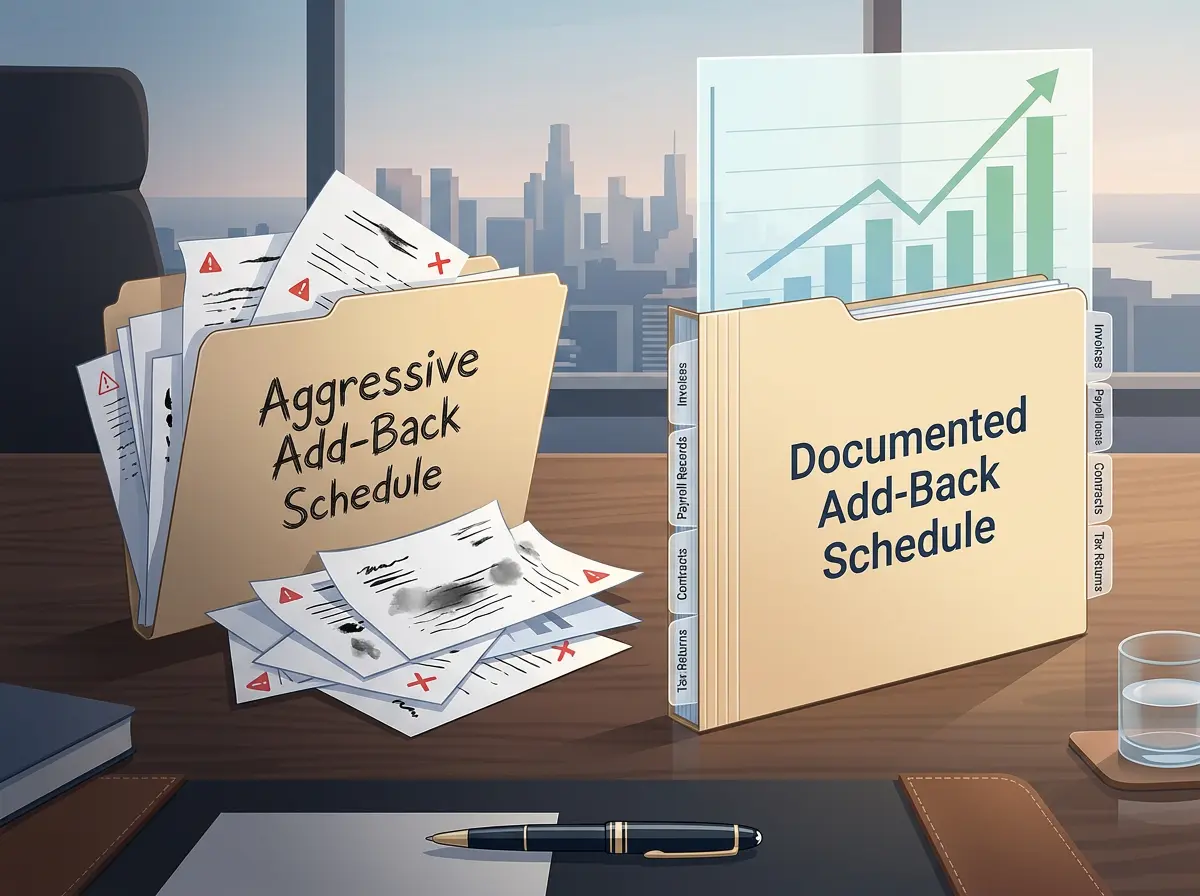
Poorly documented adjustments. This one is quiet but costly. A legitimate add-back that is not supported by documentation such as invoices, agreements, payroll records, or bank statements, and becomes a negotiating problem regardless of how valid it is. Buyers will not accept an add-back on your representation alone. They need proof!
The moment a buyer loses confidence in your add-back schedule, the conversation shifts. Instead of validating earnings, they start looking for risk. That is a fundamentally different negotiation and it almost always moves in the buyer’s favor.
The Add-Backs That Get Full Credit
The sellers who get the most value from their add-back schedule share a few common practices.
They do the work before going to market. The add-back schedule should be prepared with full documentation before the first buyer conversation. Coming to market with a clean, pre-built normalized EBITDA package signals professionalism and reduces the surface area for challenge.
They are conservative. A shorter list of well-supported adjustments is worth more than a longer list that invites scrutiny. Buyers respond to credibility. An aggressive add-back schedule runs the risk of creating doubt in the Buyer’s mind.
They can explain every line in plain language. For each add-back, there should be a simple answer to the question: why is this not part of the ongoing cost structure of the business? If the answer requires a lengthy explanation or a series of qualifications, reconsider whether the adjustment belongs on the list.
They clean up the expenses themselves before a sale. The best add-back is one you never have to make because you already removed the expense. Running fewer personal items through the business in the two to three years before a sale reduces the complexity of the conversation and eliminates a category of buyer scrutiny entirely.
What Happens When Add-Backs Fall Apart in Diligence
When a buyer’s Quality of Earnings analysis rejects or reduces add-backs, the impact on valuation is direct and immediate.
Here is how the math shakes out. If you project $1.2 million in normalized EBITDA based on $300,000 in add-backs, and a buyer’s team validates only $150,000 of those adjustments, your normalized EBITDA drops to $1.05 million. At a 4x multiple, that is $600,000 in reduction of your sale price, which might change your mind about the sale entirely.
Beyond the math, there is a credibility cost. Once a buyer has reason to question your add-backs, they have reason to question other parts of your financial presentation. That skepticism does not stay contained to the add-back schedule.
Learn more about how to pay less taxes when you sell your business: https://southcoastfp.com/5-ways-to-pay-less-taxes-when-selling-your-business/
Buyers who trust your numbers focus on upside. Buyers who do not trust your numbers focus on protection. Those are two very different deals in price, in terms, and in how smoothly the process runs.
Getting Your Add-Back Position Right Before You Go to Market
If a sale is in your planning horizon, here is where to focus.
- Work with your CPA now to identify every legitimate adjustment. Build the normalized EBITDA schedule proactively, not reactively. Know your number and know what supports it before a buyer asks.
- Audit your add-back history for patterns. If certain expenses appear consistently, assume a buyer will treat them as recurring costs and plan accordingly.
- Gather documentation for every adjustment on the list. Invoices, payroll records, tax returns, agreements. If you cannot support it on paper, do not put it on the schedule.
- Begin cleaning up personal expenses through the business. The earlier you make this separation, the cleaner your financial story becomes and the fewer adjustments you need to defend.
- Run a pre-diligence review with your advisory team. A dry run of the Quality of Earnings conversation before a buyer’s team is in the room reveals the weak points while there is still time to address them.
A well-documented, conservative add-back schedule is a credibility asset. It tells buyers that you understand your own financials, that you have been through this process thoughtfully, and that you are not trying to paper over a number that is not there. That credibility extends well beyond the add-back conversation. It sets the tone for every negotiation that follows.
If you want to understand how your current financials would hold up under a Quality of Earnings review and where your add-back position needs work, reach out to our team.
Southcoast Financial Partners works with business owners to build the financial foundation that supports successful exits. Contact our team to start the conversation.