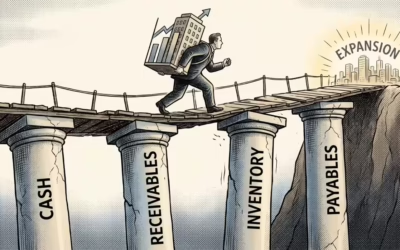
A business can be profitable, growing, and financially healthy while still carrying a major risk that does not appear clearly on the income statement.
The owner.
For many privately held companies, the founder or principal is deeply involved in nearly every important part of the business.
They may control the largest customer relationships, approve major purchases, lead sales, resolve operational problems, make hiring decisions, negotiate with vendors, and hold years of institutional knowledge that exists nowhere else.
That level of involvement may have helped build the company.
But eventually, it can also limit what the company is worth.
A buyer is not simply asking whether the business performs well today.
They are asking:
Can the business continue performing if the owner is no longer there?
That question is at the center of owner dependence.
- Owner dependence exists when too much of a company's revenue, relationships, decisions, knowledge, or operations rely on one person.
- A profitable business can still carry significant key-person risk if customers, employees, and processes depend heavily on the owner.
- Buyers may respond to owner dependence through a lower valuation, longer transition period, earnout, seller financing, or other deal protections.
- Reducing owner dependence takes time. Stronger management, documented processes, distributed customer relationships, and better financial visibility all contribute.
- A more transferable business is not only easier to sell. It is often easier to operate, grow, and manage long before a transaction occurs.
What Is Owner Dependence?
Owner dependence occurs when the performance of a business relies disproportionately on the continued presence, knowledge, relationships, or decision-making of its owner.
In an owner-dependent company, the owner may be the person who:
- Generates most new business
- Maintains the most important customer relationships
- Approves significant spending
- Sets pricing
- Negotiates major vendor agreements
- Makes most hiring decisions
- Resolves operational problems
- Understands the company's financial performance better than anyone else
- Holds important knowledge that is not documented
- Makes decisions employees are uncomfortable making independently
Some owner involvement is normal.
In many privately held businesses, the owner is one of the company's most valuable assets.
The problem begins when the business cannot function at the same level without them.
That creates what buyers often refer to as key-person risk.
Owner-Led Is Not the Same as Owner-Dependent
There is an important distinction between an owner-led business and an owner-dependent business.
An owner-led business may still benefit significantly from the owner's vision, leadership, and experience.
But the company has systems and people capable of functioning without constant owner intervention.
An owner-dependent business cannot.
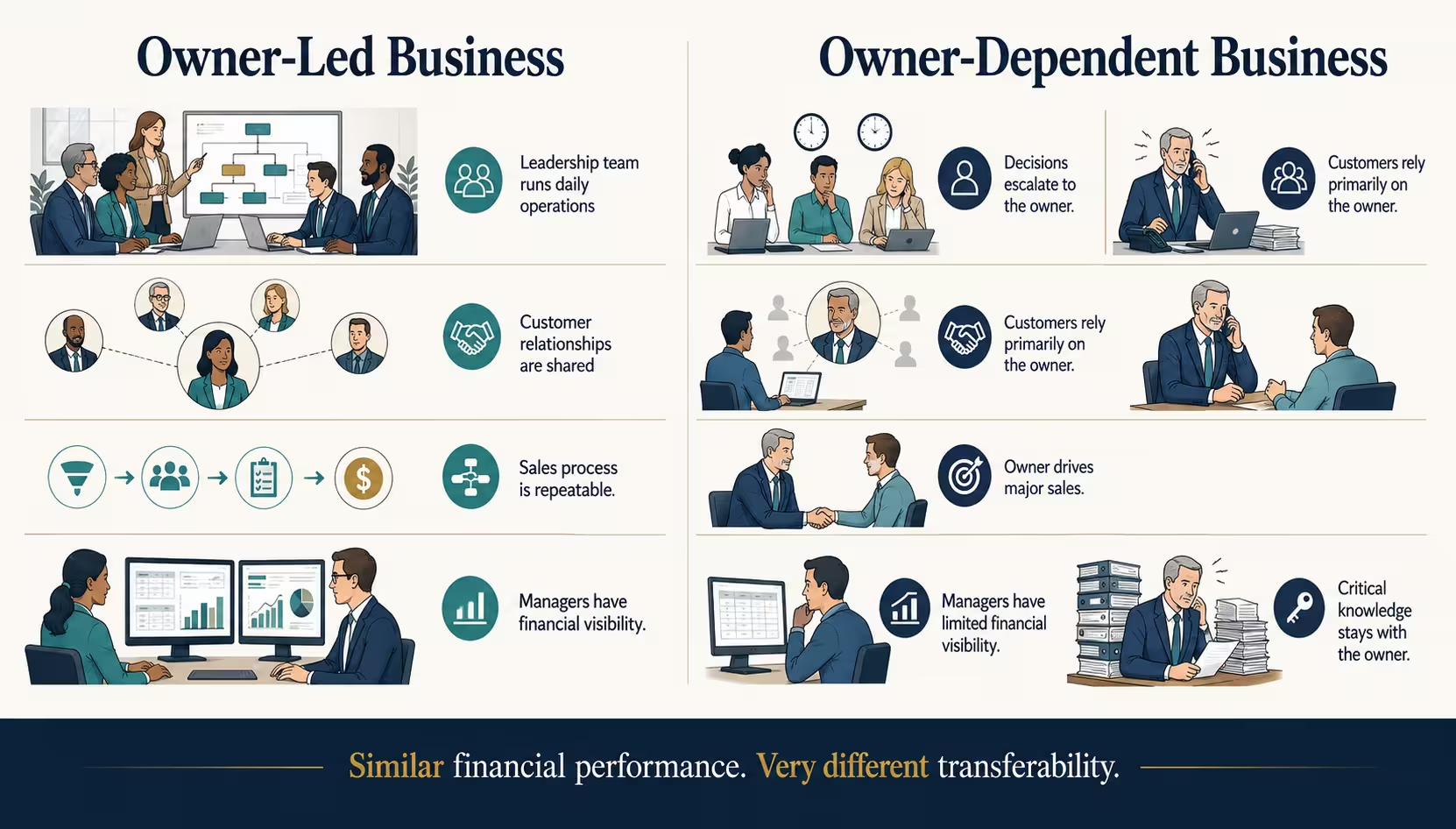
Owner-Led Business
The owner:
- Sets strategic direction
- Reviews key performance indicators
- Coaches senior management
- Maintains selected strategic relationships
- Approves major investments
- Focuses on long-term growth
Meanwhile, the management team handles most day-to-day decisions.
Owner-Dependent Business
The owner:
- Approves routine expenses
- Personally closes most major sales
- Handles customer complaints
- Sets employee schedules
- Negotiates every significant contract
- Reviews every important proposal
- Answers operational questions throughout the day
- Is required for decisions that should happen several levels below ownership
Both owners may work hard.
But the businesses have very different levels of transferability.
Why Buyers Care About Owner Dependence
When someone buys a company, they are buying its expected future performance.
That future becomes harder to predict when too much of the company's success is tied to a person who may leave after the transaction.
Imagine a company with:
- $15 million in revenue
- $2.5 million in EBITDA
On paper, the financial performance may look attractive.
But suppose the owner personally manages relationships representing 60% of revenue.
What happens when ownership changes?
Will those customers stay?
Does anyone else understand their needs?
Are contracts in place?
Can the sales team maintain those relationships independently?
Does the customer view the relationship as being with the company, or with the owner personally?
A buyer cannot simply ignore those questions.
The answers can influence how much confidence the buyer places in the company's future earnings.
The Connection Between Owner Dependence and Quality of Earnings
Owner dependence is also closely connected to Quality of Earnings.
A company may have historically generated strong EBITDA.
But if those earnings depend heavily on the owner's personal relationships or involvement, their sustainability may be less certain.
That distinction matters.
Quality of Earnings is not only about determining whether historical financial results are accurate.
It is also about understanding how repeatable those results are.
If the owner drives nearly every major sale, personally manages the largest customers, and makes most operational decisions, a buyer may question whether historical earnings can continue under new ownership.
Strong historical earnings are valuable.
Transferable earnings are more valuable.
Where Owner Dependence Usually Appears
Owner dependence can take several forms, and some are less obvious than others.
Customer Relationships
This is often one of the first areas buyers examine.
If major customers primarily interact with the owner, those relationships may be viewed as less transferable.
The issue becomes more significant when:
- The owner originated most major accounts
- Customers call the owner directly
- Contracts are informal
- Account management is concentrated with the owner
- Other employees have limited contact with key customers
A stronger business gradually moves strategic relationships from owner relationships to company relationships.
Sales
Some companies have a sales department on paper while the owner remains the actual rainmaker.
The owner may generate leads through personal relationships, handle negotiations, set pricing, and close nearly every major opportunity.
That creates a difficult question:
What happens to new business development when the owner leaves?
A buyer may place less value on a sales pipeline that depends primarily on one person's reputation or network.
Decision-Making
Owner dependence can also appear in everyday management.
If employees repeatedly say, "We need to ask the owner," that may indicate a broader organizational problem.
Routine decisions should generally happen at the appropriate level of management.
If too many decisions rise to ownership, the company can become slower, less scalable, and more difficult to transfer.
Institutional Knowledge
Privately held businesses often accumulate years of undocumented knowledge.
The owner may simply know:
- Which customers require special handling
- Which vendor terms can be negotiated
- Why certain pricing decisions were made
- How unusual operational problems are solved
- Which employees can handle specific responsibilities
- Which parts of the business are actually profitable
That knowledge has value.
But when it exists only in someone's head, it also creates risk.
Financial Management
Owner dependence is not always operational.
Sometimes the owner is the only person who truly understands the company's financial position.
They may personally monitor cash flow, interpret margins, manage banking relationships, approve capital expenditures, and understand why financial results changed from one month to the next.
If management cannot independently explain the financial performance of the business, that may be a sign that financial decision-making is too centralized.
Signs Your Business May Be Too Dependent on You
Business owners can often identify owner dependence by looking at what happens when they step away.
Consider these questions:
- Can you take a two-week vacation without being contacted daily?
- Can a major customer issue be resolved without you?
- Can your leadership team approve ordinary spending?
- Can someone else close a meaningful sale?
- Can management explain monthly financial results?
- Can employees find important processes without asking you?
- Can customer relationships survive without your involvement?
- Can your team make pricing decisions within established guidelines?
- Can your company hire and onboard employees without your direct involvement?
- Could the business operate successfully for 90 days if you were unavailable?
If the answer to many of these is no, the business may have more owner dependence than it appears.
A Simple Example: Same Earnings, Different Transferability
Consider two businesses.
Both generate:
- Revenue: $12 million
- EBITDA: $2 million
- EBITDA Margin: 16.7%
At first glance, they may appear similarly valuable.
But look more closely.
| Company A | Company B |
|---|---|
| A senior leadership team manages day-to-day operations. | The owner approves most operational decisions. |
| The largest customer has relationships with several employees. | Major customers communicate almost exclusively with the owner. |
| Sales are generated through a documented process and multiple salespeople. | The owner closes most significant sales. |
| Pricing guidelines are established. | Pricing decisions depend on owner judgment. |
| Financial reporting is reviewed monthly by management. | Management receives limited financial information. |
| Operating procedures are documented. | Important processes are undocumented. |
| The owner focuses mainly on strategy and major capital decisions. | Employees regularly escalate routine issues to ownership. |
The financial statements may look similar.
The businesses are not.
Company A is much more likely to continue operating successfully through a change in ownership.
Company B carries greater transition risk.
That difference can have a meaningful impact on value.
How Owner Dependence Can Affect a Transaction
Owner dependence does not automatically prevent a business from being sold.
But it can affect how buyers structure a deal.
Lower Valuation
A buyer may apply a lower valuation if future earnings appear less predictable without the owner.
Longer Transition Period
A buyer may require the seller to remain involved for an extended period after closing.
Instead of a short transition, the owner may be asked to stay for one or several years.
Earnouts
Part of the purchase price may depend on future performance.
For example, the seller might receive additional consideration only if revenue or EBITDA reaches certain targets after closing.
This shifts some of the transition risk back to the seller.
Seller Financing
A buyer may ask the seller to finance part of the transaction.
Again, this keeps some economic risk with the seller if the business does not perform as expected.
Retention Requirements
Buyers may place additional emphasis on retaining key employees, customers, or executives who can help bridge the transition away from owner dependence.
The common theme is risk.
The more dependent the business is on its owner, the more protection a buyer may seek.
The Cost of Owner Dependence Before a Sale
Owner dependence is not only an M&A issue.
It can constrain a business years before a transaction.
An owner who must personally handle too many responsibilities eventually becomes a bottleneck.
That can limit:
- Revenue growth
- Employee development
- Management accountability
- Geographic expansion
- New service lines
- Acquisitions
- Customer service
- Strategic planning
- The owner's own time
There is only so much one person can approve, review, sell, and manage.
At some point, the very involvement that helped build the company can prevent it from moving to the next stage.
How to Reduce Owner Dependence
Reducing owner dependence does not mean removing the owner from the business.
It means making the organization less reliant on the owner for routine success.
That transition usually happens gradually.
Build Management Depth
One of the strongest ways to reduce owner dependence is to develop leaders who can make meaningful decisions.
That may include:
- Operations leadership
- Financial leadership
- Sales leadership
- Department managers
- Project managers
- Customer relationship owners
The objective is not simply to add titles.
It is to transfer real responsibility and decision-making authority.
Document Critical Processes
Important knowledge should become organizational knowledge.
Processes worth documenting may include:
- Sales
- Pricing
- Customer onboarding
- Collections
- Purchasing
- Hiring
- Project management
- Financial close procedures
- Inventory management
- Quality control
- Customer service
Documentation does not need to become bureaucracy.
It should give the business a repeatable way to operate without relying on someone's memory.
Diversify Customer Relationships
Key customers should know more than one person at the company.
Owners can gradually introduce senior managers, account executives, and operations leaders into strategic relationships.
Over time, the customer should view the relationship as being with the organization rather than one individual.
Build a Repeatable Sales Process
Sales should become a system rather than a personality.
That can include:
- Defined lead sources
- CRM discipline
- Standard qualification processes
- Pricing guidelines
- Proposal templates
- Pipeline reporting
- Sales management
- Multiple relationship owners
The goal is to create a revenue engine that can continue operating regardless of who owns the company.
Improve Financial Visibility
Better financial information helps distribute decision-making.
When managers understand:
- Revenue
- Gross margin
- Labor utilization
- Cash flow
- Budget performance
- Forecasts
- Working capital
- Department profitability
- Key performance indicators
they can make more informed decisions without waiting for the owner.
This is one reason strong financial reporting is about more than historical accounting.
It creates the information infrastructure management needs to operate independently.
The Bigger Financial Picture
Reducing owner dependence is not only an operational exercise. It often requires accounting, forecasting, tax planning, and strategic financial management to work together.
A company cannot effectively distribute responsibility if decision-makers do not have access to reliable information.
Management needs trustworthy financial reporting.
That reporting creates visibility.
Visibility supports forecasting.
Forecasting allows managers to anticipate cash requirements, staffing needs, capital investments, and operational challenges.
When those disciplines are connected, management gains the visibility and confidence to make decisions without relying on the owner for every answer.
Over time, the company becomes less dependent on one person's intuition and more capable of making decisions through established systems and reliable information.
The goal is not only to know what happened. It is to give the organization the information it needs to decide what happens next.
For businesses that need stronger year-round financial reporting and management visibility, Client Accounting & Advisory Services (CAAS) can help build the financial foundation management relies on.
That foundation can support more forward-looking Financial Planning & Analysis (FP&A), helping leadership use forecasts, performance analysis, cash planning, and financial models to make better decisions throughout the year.
How Long Does It Take to Reduce Owner Dependence?
Usually longer than owners expect.
Customer relationships cannot be transferred overnight.
Managers do not become strong decision-makers in a few months.
Sales systems take time to mature.
Processes need to be documented, tested, and improved.
Financial reporting needs to become consistent.
That is why owner dependence is best addressed years before an anticipated transaction.
A three-to-five-year planning horizon gives owners significantly more flexibility than trying to solve the problem after a buyer has already begun due diligence.
Questions Business Owners Should Be Asking Now
You do not have to be preparing for a sale to evaluate owner dependence.
Start with questions such as:
- What decisions still require my approval?
- Which customers would be most concerned if I left tomorrow?
- What percentage of new revenue comes directly through me?
- Who besides me understands our most important customer relationships?
- Can our management team explain the company's financial performance?
- Which business processes exist only in my head?
- Who could run the company for 90 days if I were unavailable?
- Which employees are capable of taking on greater responsibility?
- Does the company have a repeatable sales process?
- Are managers measured against meaningful financial and operating KPIs?
- How much of our company's value depends directly on my continued involvement?
These are not just succession questions.
They are business-building questions.
Build a Business That Can Perform Without You
Many owners spend decades building a successful company.
But there is a meaningful difference between building a successful business and building a transferable one.
A transferable business has:
- Reliable earnings
- Strong management
- Diversified customer relationships
- Repeatable processes
- Financial visibility
- Institutional knowledge
- Independent decision-making
- A business development engine
- Operational discipline
Those characteristics can increase confidence for a future buyer.
But they also create benefits for the current owner.
The company becomes easier to manage.
Leadership becomes stronger.
Growth becomes less constrained.
Decision-making improves.
And the owner gains something that is often just as valuable as a higher valuation:
the ability to choose how involved they want to be.
That may be the clearest test of all.
A valuable business should benefit from its owner.
It should not require the owner in order to survive.
Build a More Transferable Business
Better financial visibility, stronger management systems, and proactive planning can help reduce dependence on any one individual while creating a stronger foundation for growth and an eventual transition.