
A profitable business is not automatically a predictable business.
And when a lender, investor, or potential buyer begins evaluating a company, that distinction matters.
Financial statements may show that a business generated $2 million in EBITDA last year. A Quality of Earnings analysis asks a more important question:
How much of those earnings can someone reasonably expect the business to produce again?
That is the purpose of a Quality of Earnings report, often referred to as a QoE.
For business owners, understanding Quality of Earnings is valuable even when a sale is not immediately on the horizon. The same analysis that helps a buyer evaluate a company can help an owner identify financial weaknesses, improve forecasting, strengthen operations, and build a more valuable business over time.
- A Quality of Earnings analysis evaluates how sustainable, repeatable, and reliable a company's reported earnings really are.
- Buyers typically look beyond reported EBITDA to understand adjustments, customer concentration, working capital, revenue quality, margins, and other financial risks.
- A strong QoE process starts with trustworthy financial information. Weak accounting or inconsistent reporting can create questions during a transaction.
- Business owners do not need to wait until a sale to think about Quality of Earnings. Many of the same analyses can improve decisions years before a transaction occurs.
- The quality of a company's earnings is often the result of how well the business has been financially managed over time.
What Is Quality of Earnings?
Quality of Earnings refers to the degree to which a company's reported earnings reflect the sustainable operating performance of the business.
A Quality of Earnings analysis typically starts with historical financial results and then looks beneath the headline numbers.
The goal is not simply to confirm whether the income statement is mathematically correct.
The goal is to understand what is actually producing the earnings.
For example, a company may report $2 million in EBITDA, but further analysis might reveal that:
- $250,000 came from a one-time project unlikely to repeat.
- $150,000 resulted from an unusually favorable vendor arrangement.
- One customer represents 35% of total revenue.
- The owner receives compensation materially above or below market.
- Certain expenses have been classified inconsistently.
- Gross margin has been declining even though revenue continues to grow.
None of these observations necessarily means the business is unhealthy.
They do, however, change the way someone may interpret that $2 million EBITDA figure.
That is why Quality of Earnings is less about asking "What did the business earn?" and more about asking "What does the underlying business actually earn?"
Quality of Earnings vs. an Audit
A Quality of Earnings report and a financial statement audit serve different purposes.
An audit is generally focused on whether financial statements are presented fairly in accordance with the applicable accounting framework.
A Quality of Earnings analysis is more commercially focused.
It looks at the financial information through the lens of someone evaluating the economics of the business.
A buyer may want to know:
- How much revenue is recurring?
- How dependent is the company on its largest customers?
- Are margins improving or deteriorating?
- Are there unusual expenses or income items?
- Does reported EBITDA require normalization?
- How much working capital does the business normally require?
- Are historical results consistent with management's story about the company?
A clean audit does not automatically answer those questions.
What Does a Quality of Earnings Report Analyze?
The exact scope can vary depending on the business and transaction, but several areas commonly receive significant attention.
Revenue Quality
Not all revenue carries the same level of predictability.
Recurring contractual revenue may be viewed differently than project-based revenue. Revenue spread across hundreds of customers may carry a different risk profile than revenue heavily dependent on two or three accounts.
A QoE analysis may examine:
- Revenue by customer
- Revenue by product or service
- Recurring vs. nonrecurring revenue
- Customer retention
- Customer concentration
- Monthly or quarterly revenue trends
- Pricing changes
- Revenue recognition practices
The question behind all of this is simple:
How dependable is the revenue supporting today's earnings?
Gross Margin
Revenue alone tells very little about the quality of a business.
A company may be growing rapidly while becoming less profitable with every additional dollar of revenue.
Analyzing gross margin by product, service, customer, or business line can help determine where earnings are actually being generated.
This is one reason owners benefit from looking beyond consolidated financial statements.
Total company margin may appear healthy while one service line is subsidizing another.
We explored this issue in more detail in Gross Margin by Product Line: Your Busiest Service May Be Your Least Profitable.
EBITDA Adjustments
Adjusted EBITDA is often one of the most discussed areas during a transaction.
Business owners may add back expenses they believe will not continue under new ownership.
Common examples can include:
- Owner compensation adjustments
- Personal expenses run through the company
- One-time legal or professional fees
- Nonrecurring repairs
- Unusual transaction-related expenses
- Certain discretionary costs
Some adjustments may be reasonable.
Others may be challenged.
The larger and more subjective the adjustments become, the more scrutiny a buyer is likely to apply.
A business showing $2 million of reported EBITDA with $100,000 of well-supported adjustments presents a very different story from one requiring $800,000 of adjustments to reach the same figure.
For a deeper look at this issue, see Why Your Add-Backs Won't Hold Up in Due Diligence.
Working Capital
A profitable company still needs enough working capital to operate.
Accounts receivable, inventory, accounts payable, deferred revenue, and other short-term operating accounts can have a meaningful impact on the economics of a transaction.
A QoE review may help establish what level of working capital is considered normal for the business.
That can become particularly important when buyers and sellers negotiate the amount of working capital expected to remain in the company at closing.
For more background on how working capital affects business performance, see A Business Owner's Guide to Working Capital.
Expense Trends
A company can temporarily improve earnings by delaying investments or reducing expenses that will eventually need to return.
For example, a business might postpone:
- Hiring
- Equipment maintenance
- Technology investments
- Marketing
- Facility improvements
- Professional services
Those decisions may increase short-term EBITDA while creating future obligations.
A Quality of Earnings analysis attempts to understand whether current earnings represent a sustainable operating structure.
A Simple Quality of Earnings Example
Consider two companies.
Both report:
- Revenue: $10 million
- EBITDA: $2 million
- EBITDA Margin: 20%
At first glance, they appear nearly identical.
But look beneath the numbers.
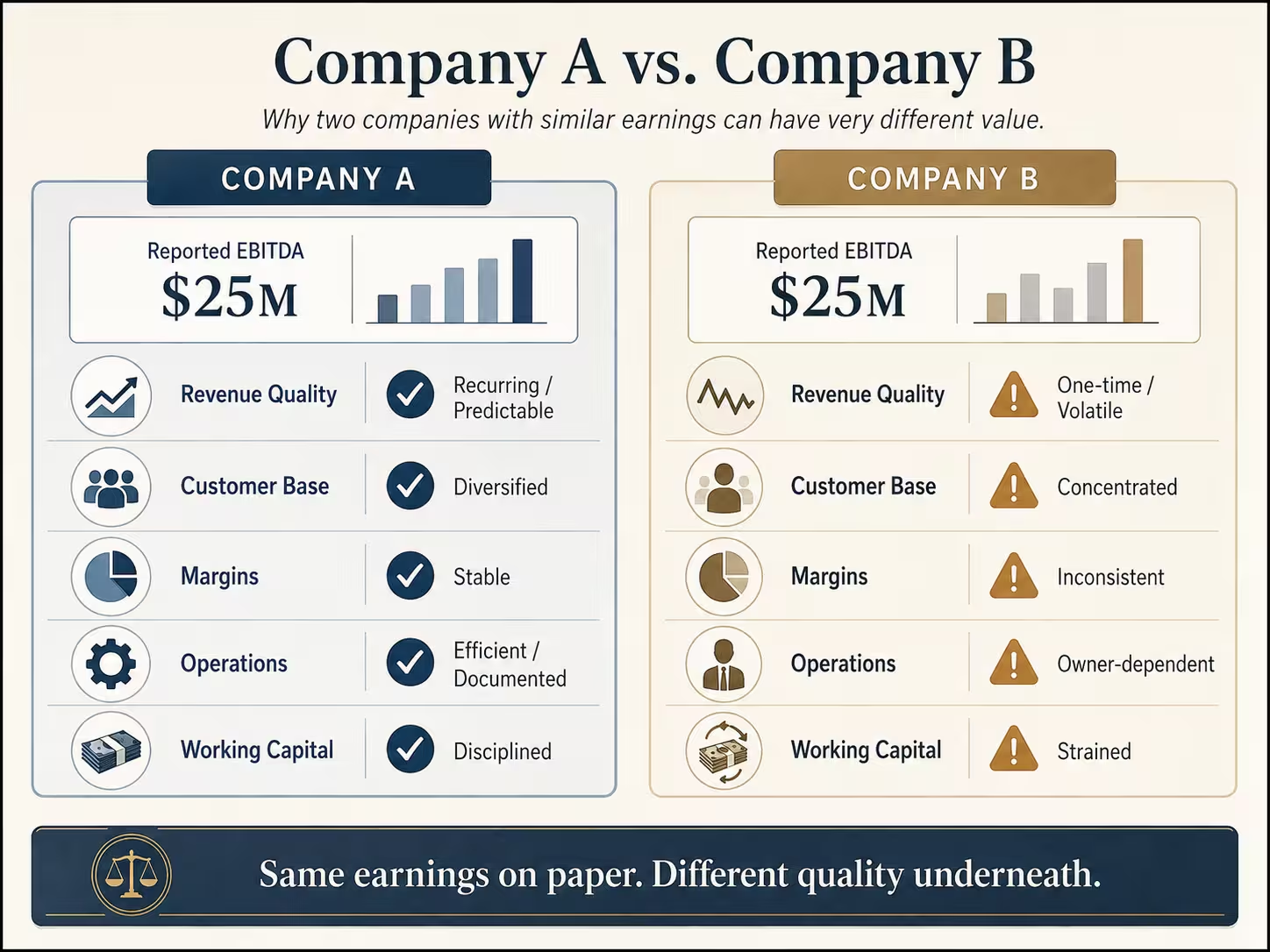
| Company A | Company B |
|---|---|
| Largest customer represents 8% of revenue. | Largest customer represents 42% of revenue. |
| Revenue has grown steadily for four years. | A major one-time project contributed significantly to last year's results. |
| Gross margins have remained consistent. | Gross margin has declined for three consecutive years. |
| Management can operate the business without the owner. | The owner controls most major customer relationships. |
| Financial statements are closed monthly. | Financial statements are regularly revised months after closing. |
| Adjusted EBITDA requires minimal normalization. | Several owner-related expenses require adjustment. |
| Customer retention is strong. | Earnings carry greater concentration and continuity risk. |
Both companies technically produced $2 million in EBITDA.
But very few buyers would view those earnings as equally valuable.
That difference is Quality of Earnings.
Why Buyers Care So Much About Quality of Earnings
A buyer is generally purchasing future cash-generating capability, not historical financial statements.
Historical earnings help establish expectations about the future, but only if those earnings are reasonably repeatable.
The more uncertainty surrounding earnings, the more risk a buyer may perceive.
That risk can influence:
- Valuation
- Deal structure
- Financing
- Required working capital
- Earnouts
- Seller notes
- Representations and warranties
- Due diligence requirements
This is why two businesses with similar revenue and EBITDA can ultimately receive very different valuations.
The number matters.
The confidence someone has in that number matters too.
Quality of Earnings Starts Long Before a Transaction
This is where many business owners approach the process backward.
They begin thinking about financial diligence when a potential buyer appears.
But a Quality of Earnings report does not create financial quality.
It reveals it.
The foundation is built much earlier.
Reliable monthly financial reporting, consistent accounting practices, meaningful management reporting, documented adjustments, customer-level analysis, accurate margins, working capital management, and forward-looking forecasting all contribute to the financial story a business eventually presents.
A business that has spent years developing that discipline is in a very different position from one attempting to reconstruct its financial history during due diligence.
Strong transaction readiness is rarely the result of one project completed immediately before a sale.
It develops through connected financial disciplines.
First, management needs financial information it can trust. That creates the foundation for meaningful analysis.
Better analysis makes it possible to identify trends, understand margins, forecast cash requirements, plan taxes, allocate capital, and make informed growth decisions.
Over time, those decisions can strengthen the very characteristics a buyer eventually evaluates.
This is why financial reporting should do more than document where a business has been. It should help management decide where the business is going.
For businesses that need stronger year-round reporting and financial visibility, Client Accounting & Advisory Services (CAAS) can help build the financial foundation management relies on.
That foundation can then support more forward-looking Financial Planning & Analysis (FP&A), including forecasting, scenario planning, profitability analysis, cash flow planning, and strategic decision-making.
When Should a Business Consider a Quality of Earnings Analysis?
The most obvious answer is during a transaction.
But there are several situations where thinking through Quality of Earnings can be useful.
Before Selling the Business
A sell-side Quality of Earnings analysis can help owners identify potential diligence issues before buyers discover them.
That may allow management to:
- Address accounting inconsistencies
- Better document EBITDA adjustments
- Understand customer concentration
- Analyze working capital
- Explain unusual financial periods
- Develop clearer supporting schedules
The objective is not to manufacture a better financial story.
It is to understand the real story before entering negotiations.
For owners approaching a transaction, Southcoast FP's M&A Advisory Services can help support transaction planning, financial analysis, valuation considerations, and due diligence preparation.
Before Raising Capital
Investors will often evaluate many of the same characteristics as an acquirer.
They want to understand whether growth is sustainable, margins are attractive, and financial information is reliable.
Before Refinancing or Seeking Significant Debt
Lenders care about the company's ability to generate consistent earnings and cash flow.
Understanding earnings quality can help management anticipate questions before approaching financing sources.
During Rapid Growth
Rapid growth can hide financial problems.
Revenue may increase while margins fall, working capital requirements rise, or customer concentration becomes more pronounced.
Analyzing the quality behind reported earnings can help management determine whether growth is actually strengthening the business.
Years Before an Exit
This may be the most valuable time of all.
If an owner intends to sell the company in three to five years, understanding what could eventually concern a buyer creates time to improve it.
Customer concentration can be reduced.
Management responsibilities can be distributed.
Reporting can be improved.
Margins can be analyzed.
Recurring revenue can be developed.
Financial processes can mature.
Those improvements are much harder to accomplish six months before a transaction.
Questions Business Owners Should Be Asking Now
You do not need to be selling your company to think like a buyer.
Consider asking:
- How much of our revenue is recurring?
- What percentage of revenue comes from our largest five customers?
- Which products or services generate our strongest margins?
- How much of EBITDA depends on adjustments?
- How predictable are our monthly results?
- How quickly can we produce accurate financial statements?
- Can management explain major variances from budget or forecast?
- How much working capital does the business require?
- How dependent is the company on the owner?
- What would an outside buyer question about our financial results?
Those are not simply M&A questions.
They are good management questions.
A Quality of Earnings Mindset
The biggest takeaway for business owners is not that every company needs to order a formal Quality of Earnings report tomorrow.
It is that the characteristics buyers examine during diligence are often the same characteristics that make a business stronger today.
Predictable revenue.
Healthy margins.
Reliable financial information.
Diversified customers.
Disciplined working capital management.
A capable management team.
Well-supported earnings.
Strong businesses tend to build these qualities long before anyone begins discussing a transaction.
That is why the best preparation for a future sale is often simply running a financially disciplined business today.
Looking Beyond the Number
EBITDA can help establish an earnings base.
Quality of Earnings helps determine how much confidence someone should place in that base.
For business owners, that distinction matters whether a sale is five months away, five years away, or not currently part of the plan at all.
The ability to understand what is driving earnings, identify risks early, and use financial information to make decisions is valuable at every stage of the business.
Because when the numbers are trustworthy and connected to the strategy, financial reporting becomes more than a record of what happened.
It becomes a tool for deciding what happens next.
Build the Financial Foundation Before You Need It
Whether you are preparing for growth, financing, outside investment, or an eventual transaction, stronger financial visibility can help you identify risks earlier and make more informed decisions.