Most manufacturers already have more data than they know what to do with.
The challenge is deciding which numbers actually deserve management's attention.
Revenue and EBITDA are important, but they are outcome metrics. They tell you where the business landed. They do not always explain what drove the result or where the next problem may be developing.
For a growing manufacturer, the more useful questions are often more specific.
Which customers are producing the strongest margins? How much cash is tied up in inventory? Is overtime becoming a capacity problem? Is backlog translating into profitable work? Are equipment investments producing the return management expected?
A good financial scorecard should help answer those questions.
The goal is not to track every available data point. It is to identify the financial and operating measures that give owners a clearer view of profitability, cash flow, capacity, and risk.
- Revenue and EBITDA are important, but they do not explain what is driving performance.
- Manufacturers should connect financial results with labor, customers, inventory, production, and capacity.
- Working capital metrics can reveal pressure that may not be obvious on the income statement.
- The best scorecards focus on trends, exceptions, and decisions rather than reporting more numbers.
- Financial and operational information should work together to give ownership a clearer view of the business.
Four Areas Every Growing Manufacturer Should Be Watching
A useful manufacturing scorecard does not need dozens of disconnected KPIs.
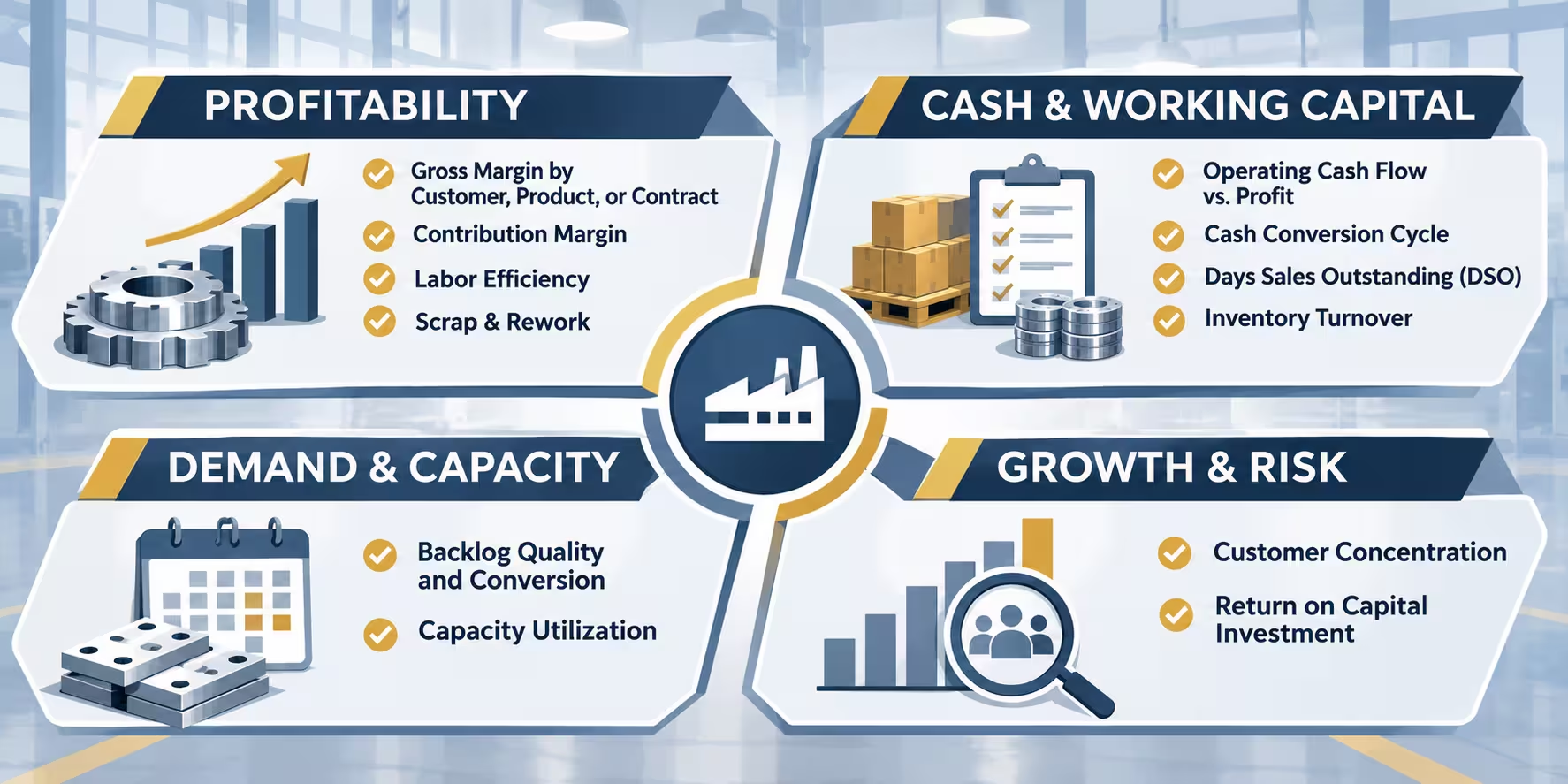
For many growing companies, the most important measures fall into four areas:
- Profitability: Where is the business actually making money?
- Cash and working capital: How efficiently are earnings turning into cash?
- Demand and capacity: Can the operation support the work being sold?
- Growth and risk: Where is capital being deployed, and where is the business exposed?
Looking at these areas together provides a much more useful picture than relying on revenue or EBITDA alone.
Profitability: Know Where the Economics Are Working
Company-wide gross margin is a useful starting point, but advanced manufacturers often need more detail than that.
A $2 million customer relationship can produce very different economics from another $2 million account. One may require significant engineering support, frequent change orders, overtime, expedited materials, or unusually tight quality requirements.
The top line looks the same. The contribution to the business may not.
1. Gross Margin by Customer, Product, or Contract
Breaking gross margin down by the way the business actually operates can reveal where profitability is strongest and where it is being compressed.
Depending on the company, that might mean looking at margin by customer, product family, program, job, or contract.
This becomes particularly important when leadership is deciding which types of work to pursue, where to increase pricing, or which customer relationships deserve additional capacity.
2. Contribution Margin
Contribution margin can help management evaluate incremental work by showing how much remains after the variable costs required to produce it.
This can be especially useful when considering a large order, another production shift, or additional volume from an existing customer.
The question is not simply whether the work produces revenue. It is whether that additional work contributes enough to justify the labor, materials, capacity, and risk involved.
3. Labor Efficiency and Overtime
Total payroll does not tell an owner much about how efficiently labor is being used.
Direct labor hours, overtime, estimated versus actual labor, and labor cost relative to production can provide a much clearer picture.
Persistent overtime deserves particular attention. It may point to stronger demand, but it could also signal scheduling problems, a hiring gap, inefficient workflow, or a production constraint.
4. Scrap, Rework, and Yield
Quality issues eventually become financial issues.
Scrap consumes material. Rework consumes labor and machine time. Both can reduce available capacity and delay customer shipments.
For that reason, operational quality measures should not live only on the plant floor. Ownership should understand the financial cost associated with them and how those costs are affecting margin.
Cash and Working Capital: Profitability Is Only Part of the Picture
Manufacturers often invest cash long before they collect from the customer.
Materials are purchased. Labor is added. Inventory builds. Work moves through production. The customer may not pay until weeks or months later.
That operating cycle makes working capital especially important.
5. Operating Cash Flow Compared With Profit
If earnings are improving but cash generation is consistently lagging, there is usually a reason worth investigating.
The difference may be tied to receivables, inventory, supplier payments, growth, or capital spending.
Comparing profit with operating cash flow helps ownership see whether reported earnings are actually turning into liquidity.
6. Cash Conversion Cycle
The cash conversion cycle brings receivables, inventory, and payables together into one view of how long cash remains tied up in operations.
The trend is often more useful than a single calculation.
If the cycle is getting longer, the business may need more cash to support the same level of activity.
We explore this in more detail in Cash Conversion Cycle: Why Profitable Businesses Still Run Out of Cash.
7. Days Sales Outstanding
Days Sales Outstanding, or DSO, shows how quickly customers are paying.
A rising DSO can create pressure quickly in a growing company because the manufacturer may be financing more materials and production while collections slow down.
Looking at DSO by major customer can also be revealing. A company-wide average may hide one or two accounts that consistently stretch payment terms.
8. Inventory Turnover and Inventory Days
Inventory is necessary, but it is also capital sitting inside the operating cycle.
Management should understand whether inventory growth is supporting expected demand or whether cash is becoming tied up in slow-moving material, excess purchasing, unfinished work, or obsolete stock.
That is why inventory measures belong in the same conversation as cash flow and working capital.
Demand and Capacity: Can the Business Support What It Is Selling?
A healthy sales pipeline is only valuable if the business has the capacity and economics to perform the work.
This becomes increasingly important as manufacturers pursue larger programs, add customers, or enter defense and government contracting.
9. Backlog Quality and Conversion
Backlog is often treated as a straightforward indicator of future demand.
It deserves more context.
Leadership should know when the work is expected to ship, what margin it carries, which customers account for it, and what production resources will be required to complete it.
A large backlog with weak margins or significant working capital requirements may create a very different financial outcome than the headline number suggests.
For manufacturers pursuing government or defense work, contract-level visibility becomes even more important. We discuss that in Financial Readiness for Defense Contractors.
10. Capacity Utilization
Capacity planning should help answer a simple question: if the company wins more work, can it deliver it profitably?
Constraints may come from equipment, labor, engineering, floor space, quality control, or suppliers.
Operating near full utilization can look efficient, but it also leaves less flexibility for a major order, equipment downtime, or customer schedule changes.
That is why capacity information should feed directly into forecasting and capital planning rather than remain only an operational measure.
Growth and Risk: Understand What the Business Is Becoming
Growth changes the risk profile of a company.
A manufacturer may become larger while also becoming more dependent on a single customer, more capital intensive, or more reliant on a small number of key employees.
Owners need measures that show not only where the company is today, but what kind of business it is becoming.
11. Customer Concentration
Revenue concentration is an obvious starting point, but profit concentration may be just as important.
A customer representing 15% of revenue could represent a much larger percentage of earnings if the work carries unusually strong margins.
That makes the company's financial exposure greater than the revenue percentage alone suggests.
Tracking concentration over time can help ownership see whether growth is creating diversification or simply increasing dependence on the same major accounts.
We discuss this issue further in Customer Concentration Risk: When Too Much Revenue Comes From Too Few Customers.
12. Return on Capital Investment
Manufacturers regularly deploy significant capital into equipment, automation, facilities, tooling, and technology.
The decision should not end with whether the business can afford the purchase.
Ownership should have a clear expectation for what that investment is supposed to accomplish.
Will it increase capacity? Reduce labor? Improve margins? Lower scrap? Shorten lead times? Enable a new customer or contract?
The answer provides the basis for evaluating whether the investment is actually performing as planned.
For larger capital decisions, management may also consider payback period, cash flow impact, net present value, or sensitivity analysis. NIST's manufacturing-focused Smart Investment Tools provide additional guidance on evaluating manufacturing investments. Learn more from NIST.
A Scorecard Should Lead to a Conversation
The purpose of these metrics is not to create a twelve-page management report.
A useful scorecard should make it easier to see what changed and decide where leadership needs to spend its attention.
If gross margin drops, the conversation may move toward labor, materials, pricing, or scrap.
If cash tightens, the discussion may shift toward receivables, inventory, growth, or supplier terms.
If backlog increases sharply, the next question may be whether existing capacity can support it.
The metrics provide signals. The real value comes from understanding what those signals mean for the business.
The Dashboard Should Match the Business
Not every manufacturer needs to track the same twelve measures with the same level of detail.
A contract manufacturer may care deeply about job margins and labor efficiency. A company with significant inventory may place greater emphasis on turnover and working capital. A rapidly expanding operation may spend more time on capacity and capital returns.
The right scorecard depends on the company's economics, strategy, and current priorities.
This is why adding more KPIs is not necessarily an improvement.
NIST has emphasized that manufacturing KPIs should connect to strategic objectives and critical success factors rather than exist as measurements for their own sake. Read the NIST research.
Good Reporting Starts With Reliable Information
There is one practical limitation to every management dashboard: the underlying numbers have to be trustworthy.
If customer profitability cannot be reconciled to the accounting system, inventory reporting is inconsistent, or financial statements arrive too late to influence decisions, adding more analysis will not solve the problem.
The foundation comes first.
Client Accounting & Advisory Services can help create timely, reliable financial information.
FP&A can then use that information to forecast, evaluate scenarios, and help ownership understand the financial impact of operational decisions.
That connection matters.
The accounting team, operations team, tax advisor, and business owner should not each be working from a different version of the company's financial picture.
Use the Numbers to Run the Business
The best manufacturing metrics do more than describe performance.
They help owners decide where to focus, where to invest, and where risk may be building.
Revenue and EBITDA still matter. They simply become more useful when ownership understands what is driving them.
That is the broader objective of an integrated financial approach for growing manufacturers: connect accounting, operations, cash flow, forecasting, tax planning, and strategy so the entrepreneur can see the business more clearly.
The goal is not more reporting. It is better information for better decisions.
If your manufacturing business is growing and you need better visibility into profitability, working capital, forecasting, or capital decisions, contact Southcoast Financial Partners to discuss how an integrated financial approach can support your next stage of growth.