
Winning a defense or federal contract can create a significant growth opportunity for a manufacturer.
It can also expose weaknesses in the financial side of the business very quickly.
Government contracting can introduce a different level of scrutiny around how costs are tracked, how labor is recorded, how indirect expenses are allocated, and how financial records support the amounts being proposed or billed.
For manufacturers accustomed primarily to commercial work, the transition can require more than simply adding a new customer.
It may require a stronger financial infrastructure.
The goal is not to build a more complicated accounting system than the business needs.
It is to make sure the company can clearly answer a fundamental question:
Can we show where the money went, why it was charged that way, and whether the contract is actually profitable?
- Government and defense work can require greater visibility into direct costs, indirect costs, labor, and contract-level profitability.
- Financial requirements vary by contract type and award, so manufacturers should understand the specific requirements associated with the opportunities they pursue.
- Strong job costing and timekeeping help management understand what each contract actually costs to perform.
- Winning larger contracts can create substantial working capital requirements before the resulting cash is collected.
- Financial readiness should begin before a major award, not after the company is already trying to perform under it.
Government Work Changes the Financial Conversation
Commercial manufacturers are already accustomed to managing materials, labor, overhead, margins, inventory, and customer requirements.
Government contracting does not replace those fundamentals.
It can make some of them much more important.
When federal contract costs are being analyzed or reimbursed, the Federal Acquisition Regulation provides principles addressing areas such as cost allowability, reasonableness, allocability, direct costs, and indirect costs. Those principles are contained in FAR Part 31: Contract Cost Principles and Procedures.
That does not mean every government contract is subject to the same accounting requirements.
A firm-fixed-price award can create a very different financial environment from a cost-reimbursement contract.
Manufacturers should therefore understand the requirements of the specific opportunities they intend to pursue rather than assuming there is one accounting standard for every federal contract.
1. Know Your True Cost by Contract
One of the most important financial capabilities for a growing government contractor is the ability to understand costs at the contract or job level.
That may include:
- Direct labor
- Direct materials
- Outside processing
- Subcontractor costs
- Freight
- Equipment usage
- Other contract-specific expenses
Under FAR 31.202, costs identified specifically with a contract are treated as direct costs of that contract when the applicable federal cost principles apply.
For management, however, contract costing is not simply a compliance issue.
It is a profitability issue.
A manufacturer can win more contracts, add employees, increase production, and report higher revenue while simultaneously taking on work that produces weaker margins than expected.
If the financial system cannot show what each contract actually costs, leadership may not recognize the problem until much later.
2. Separate Direct and Indirect Costs Clearly
Manufacturers also incur expenses that support multiple contracts or the overall business.
Depending on the company, those may include:
- Facility costs
- Production supervision
- Quality functions
- Utilities
- Administrative personnel
- Accounting
- Information technology
- Certain equipment-related costs
The financial system needs a consistent method for distinguishing costs attributable directly to a contract from costs supporting multiple contracts or operations.
FAR 31.203 addresses indirect costs and the use of logical cost groupings and allocation bases when those federal cost principles apply.
This distinction also matters commercially.
Without a reliable allocation methodology, management can underestimate the true resources required to perform a contract and overestimate the margin it is producing.
3. Understand Your Indirect Cost Structure
A manufacturer may know its total overhead.
That is not the same as understanding how overhead affects individual contracts.
Management should be able to answer questions such as:
- Which costs belong in manufacturing overhead?
- Which costs are administrative or company-wide?
- What allocation methods are being used?
- Are those methods being applied consistently?
- How will indirect rates change if contract volume changes?
This last question is particularly important for a company preparing to scale.
Suppose a manufacturer expands its facility, adds quality personnel, invests in new systems, or increases administrative capacity in anticipation of additional government work.
Those investments may increase the company's indirect cost base before the expected contract volume fully arrives.
If management is not forecasting that change, a contract that looked attractive during bidding may produce a very different margin after production begins.
4. Build Reliable Labor and Timekeeping Processes
Labor can be one of the most significant costs in advanced manufacturing and defense work.
For companies subject to applicable government accounting requirements, labor needs to be captured in a way that properly assigns employee time to the appropriate cost objectives.
The DCAA Pre-Award Accounting System Checklist, for example, addresses both timekeeping and labor distribution when evaluating accounting systems for certain prospective contractors.
Even when a formal review is not involved, accurate labor tracking gives management much better information.
It can help answer:
- How many labor hours did the contract actually require?
- Did engineering time exceed the estimate?
- Were setup and rework greater than anticipated?
- Are certain contracts consuming disproportionate management resources?
- Is the company's labor rate still adequate?
Without reliable labor information, contract profitability can become largely theoretical.
5. Make Sure Contract Detail Connects to the General Ledger
A job-cost report should not exist in isolation from the company's accounting records.
Contract-level financial information should ultimately connect back to the broader general ledger.
DCAA's pre-award checklist specifically asks whether an accounting system can accumulate costs under general ledger control and identify labor by appropriate cost objectives.
From a management perspective, that same structure provides an important benefit even when an audit is not involved.
Leadership should be able to move from:
Company revenue → Contract revenue → Contract cost → Contract margin
without depending on disconnected spreadsheets that cannot easily be reconciled.
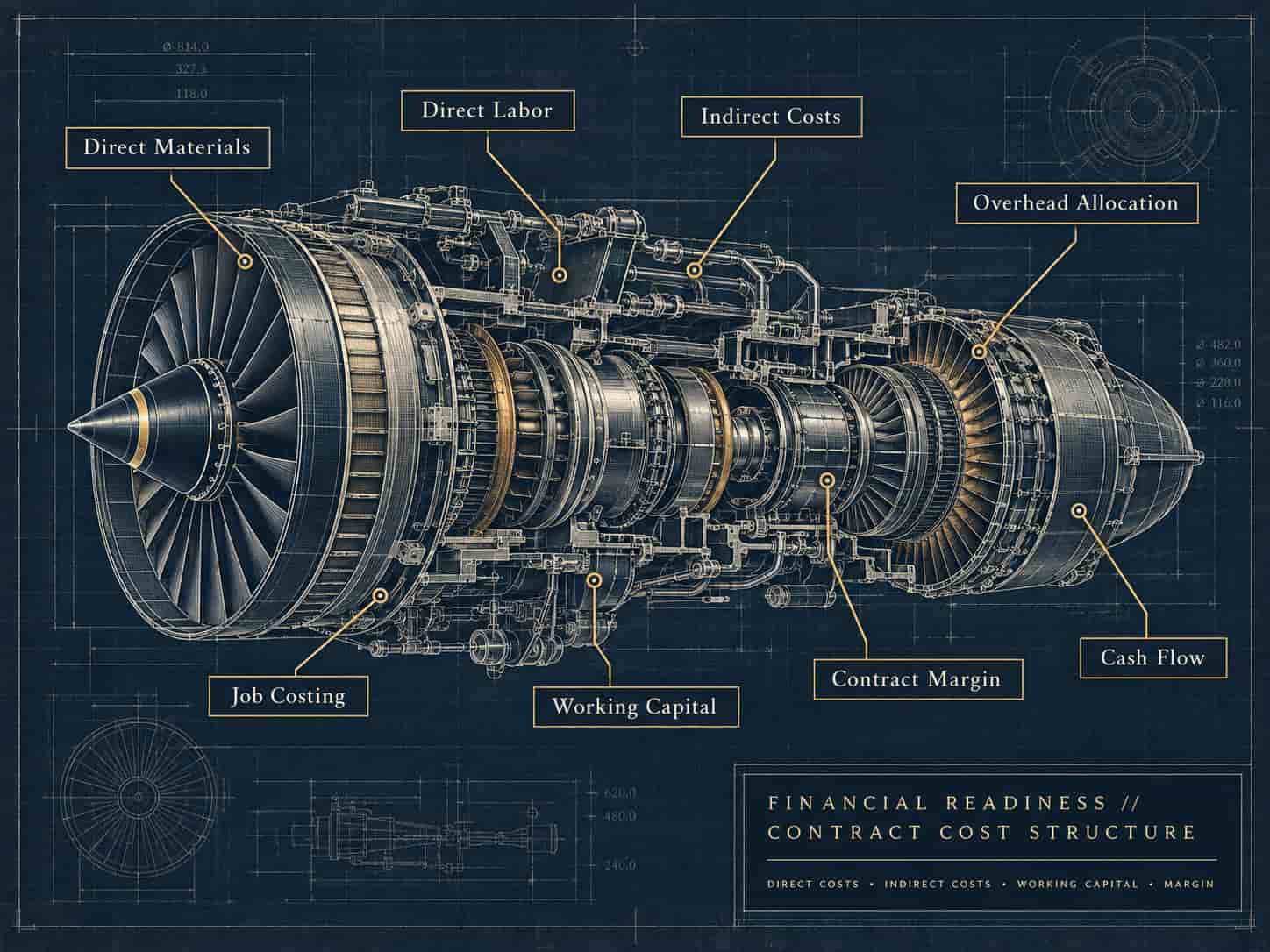
The financial infrastructure behind a government contract is interconnected. Direct costs, labor, overhead, working capital, margin, and cash flow ultimately need to tell the same financial story.
6. Watch the Working Capital Impact of Winning
A major defense contract can look attractive on the income statement and still create substantial cash pressure.
Manufacturers frequently need to spend money before they collect it.
That may include:
- Raw materials
- Specialized inventory
- Additional employees
- Overtime
- Equipment
- Tooling
- Quality systems
- Technology and cybersecurity improvements
- Subcontractors
- Facility expansion
This is where a growth opportunity can create a financing gap.
A company may have a profitable contract and still need significant liquidity to perform the work successfully.
Before pursuing a larger award, management should model:
How much cash will we need before this contract begins generating positive cash flow?
That question connects directly to both working capital and business cash reserves.
7. Forecast Before You Add Capacity
Government opportunities can encourage manufacturers to invest ahead of demand.
That may be necessary, but it should be modeled carefully.
A manufacturer preparing for a significant new program may be considering:
- New CNC equipment
- Additional production space
- Additional shifts
- Engineering hires
- Quality personnel
- Software systems
- Inventory
- Specialized tooling
The financial question is not simply whether the company can afford those investments today.
It is whether the expected contract economics justify them across several possible outcomes.
| Scenario | What Management Should Evaluate |
|---|---|
| Award received on schedule | Staffing, equipment, working capital, and expected contract margin. |
| Award delayed | Carrying cost of additional personnel, equipment, and capacity. |
| Award smaller than expected | Ability to absorb the additional fixed-cost structure. |
| Award not received | Alternative uses for new equipment, employees, and production capacity. |
| Volume exceeds expectations | Additional labor, working capital, equipment, and supplier requirements. |
This is where financial planning becomes part of business development.
8. Understand the Difference Between Revenue and Contract Profitability
Government work can produce significant revenue.
That does not automatically mean it produces attractive returns.
A contract may also require:
- Additional documentation
- More quality control
- Specialized personnel
- Greater engineering involvement
- Capital investment
- Additional administrative support
- Higher working capital requirements
Those costs need to be reflected in the economics of the work.
Management should evaluate contracts using measures such as:
- Gross margin
- Contribution margin
- Labor efficiency
- Material variance
- Indirect cost absorption
- Working capital requirements
- Cash conversion
- Return on invested capital
The objective is not simply to win work.
It is to win work the company can perform profitably and finance responsibly.
9. Prepare for Greater Documentation
Government contracting can also require stronger supporting documentation when federal cost principles apply.
FAR Part 31 places importance on properly accounting for contract costs and supporting those costs when determining allowability.
For a growing manufacturer, strong documentation may include:
- Purchase orders
- Vendor invoices
- Labor records
- Job-cost reports
- Contract files
- Expense support
- Allocation methodologies
- Written accounting procedures
This should not be viewed simply as paperwork.
Strong documentation also improves internal controls and gives management greater confidence in the financial information being used to make decisions.
10. Know When Formal Government Accounting Requirements Apply
This distinction is important.
Not every manufacturer pursuing federal work needs the same accounting infrastructure.
DCAA's Pre-Award Accounting System Adequacy Checklist is intended for contractors new to government contracting that have cost-reimbursement contracts, or contractors receiving progress payments, to document how their systems are designed to address the applicable SF 1408 criteria.
Manufacturers should determine early:
- What type of contract is being pursued?
- Will cost analysis be involved?
- Are cost-reimbursement provisions applicable?
- Are there specific agency requirements?
- Could a pre-award accounting system review apply?
- Are there requirements that may extend to subcontractors?
Answering those questions may require input from government contracting specialists, legal counsel, procurement advisors, and accounting professionals.
The important point is to understand the requirements before the award.
Financial Readiness Before the Opportunity Arrives
A manufacturer does not need to wait until it wins a defense contract to strengthen its financial infrastructure.
In many cases, that is the worst time to begin.
Before pursuing larger government opportunities, leadership should understand whether the company can reliably produce:
- Contract-level cost reporting
- Direct and indirect cost visibility
- Accurate labor information
- Consistent overhead allocation
- Cash flow forecasts
- Working capital projections
- Contract profitability analysis
- Reliable supporting documentation
Those capabilities may help support applicable contracting requirements.
More importantly, they help management determine whether an opportunity makes economic sense.
A Practical Financial Readiness Checklist
- Can we track costs by contract?
- Can we separate direct and indirect costs consistently?
- Do we understand our overhead structure?
- Can we accurately capture labor by job or contract?
- Can our contract reports reconcile to our accounting system?
- Do we know which costs are driving margin?
- Have we modeled the working capital required to perform the contract?
- Can we forecast the effect of additional equipment and staffing?
- Do we know what happens financially if an award is delayed?
- Do we understand the accounting requirements associated with the specific contract type?
- Do we maintain documentation supporting our financial records?
- Can management clearly determine whether the contract is actually profitable?
If several of those questions are difficult to answer, the company may have financial work to do before it has a contracting problem.
The Bigger Financial Picture
Defense contracting can be an attractive growth strategy for advanced manufacturers.
But growth should be supported by a financial infrastructure capable of keeping pace with the complexity of the work.
Reliable accounting provides accurate cost information.
Job costing reveals contract economics.
Working capital planning shows how the work will be financed.
Forecasting helps management evaluate investments before committing capital.
Tax planning helps leadership consider the implications of equipment purchases, hiring, and expansion.
Financial analysis helps determine whether the opportunity is actually creating value.
Winning the contract is only the beginning.
Through Client Accounting & Advisory Services (CAAS), growing manufacturers can build stronger financial reporting, accounting processes, and management visibility.
More forward-looking Financial Planning & Analysis (FP&A) can then help leadership model contract economics, working capital requirements, capacity investments, and different growth scenarios.
Build the Financial Infrastructure Before You Need It
The opportunity to enter or expand within the defense supply chain can be significant.
But the strongest manufacturers do more than build sophisticated products.
They understand the financial mechanics behind the work.
They know what contracts cost.
They understand how overhead is being absorbed.
They know how much cash growth will require.
And they can evaluate whether a contract is creating long-term value before committing additional people, equipment, and capital.
The question is not simply:
Can we win the contract?
It is:
Are we financially ready to perform it successfully?
Prepare the Financial Side of Your Growth Strategy
Southcoast Financial Partners helps privately held businesses strengthen financial visibility, forecasting, working capital planning, and strategic decision-making as they prepare for growth.