Most manufacturers build an annual budget.
The problem is that very little about manufacturing stays fixed for an entire year.
Material costs change. Hiring takes longer than expected. Customers move orders. Equipment requires maintenance. Production schedules shift. New contracts are awarded. Other opportunities get delayed.
A budget tells management what it expected to happen.
A forecast tells management what it now believes is going to happen.
For growing manufacturers, especially those operating in advanced manufacturing, aerospace, defense, medical device, or other complex production environments, both are important.
- A budget establishes the financial plan for the year.
- A forecast updates expectations based on what is actually happening in the business.
- Manufacturers face variables such as labor, materials, backlog, capacity, equipment, and contract timing that can quickly make an annual budget outdated.
- Rolling forecasts can help management make better decisions around hiring, capital spending, cash, and production capacity.
- The goal is not to predict the future perfectly. It is to make better decisions with the information available today.
What Is the Difference Between a Budget and a Forecast?
A budget is generally built before the start of a fiscal year and reflects management's expectations for revenue, expenses, hiring, capital expenditures, margins, and profitability.
It creates a financial framework for the year ahead.
A forecast serves a different purpose.
Instead of asking, "What did we expect to happen?" a forecast asks, "Based on what we know today, what are we expecting now?"
That distinction becomes increasingly important as a company grows.
| Budget | Forecast |
|---|---|
| Built around an annual plan | Updated as conditions change |
| Sets financial expectations | Revises financial expectations |
| Useful for accountability | Useful for decision-making |
| Usually remains relatively static | Changes with the business |
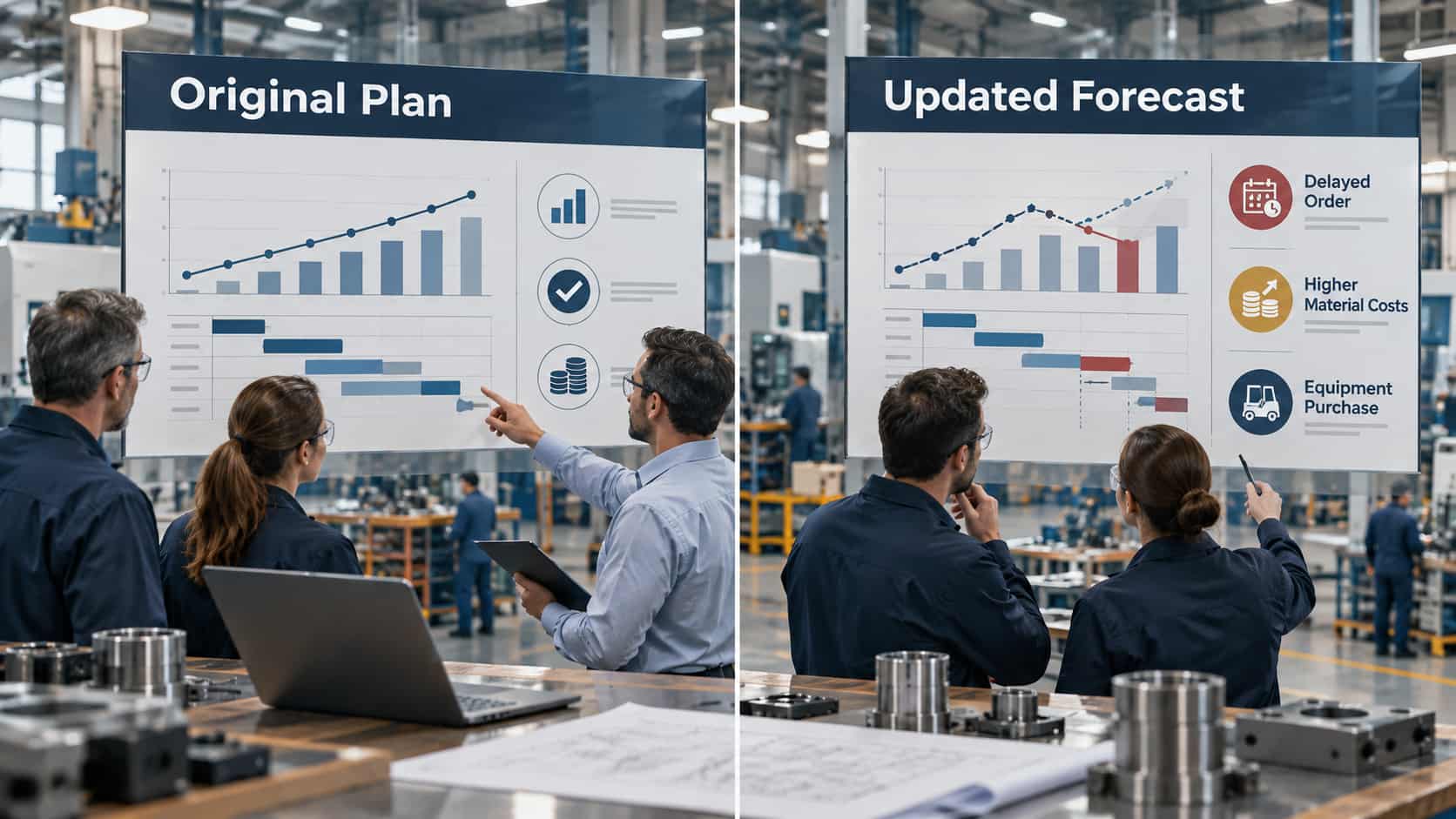
| Shows the original plan | Shows the current expected outcome |
The two are not competing tools. They answer different questions.
Why Forecasting Matters More as a Manufacturer Grows
Manufacturing businesses often operate with more moving parts than a traditional service business.
Revenue may depend on production capacity, backlog, customer schedules, labor availability, material lead times, equipment utilization, and the timing of large orders.
Expenses can move just as quickly.
A manufacturer might enter the year expecting a certain gross margin, only to see material prices increase, overtime rise, or production inefficiencies begin affecting profitability.
If management continues operating solely from the original budget, the financial plan may no longer reflect the business it is actually running.
Forecasting creates an opportunity to adjust before those changes become surprises at year-end.
A Simple Manufacturing Example
Consider a manufacturer that enters the year with the following plan:
- $18 million in revenue
- 28% gross margin
- 80 employees
- $1.2 million in planned equipment purchases
- Stable material costs
- Continued growth from its largest customers
By the middle of the year, the picture looks different.
- A major customer pushes an order into the following quarter.
- Material costs are running 8% above plan.
- Six production positions remain unfilled.
- Overtime is materially higher than expected.
- A new defense-related opportunity could require additional tooling and working capital.
The original budget is still useful. It shows where actual performance is diverging from the plan.
But it should no longer be the only financial view management is using.
A revised forecast can help leadership understand what the new revenue outlook means for cash flow, margin, hiring, production capacity, and capital spending.
Forecasting Helps Connect Operations to Finance
One of the most valuable benefits of forecasting is that it forces operational decisions and financial results into the same conversation.
For manufacturers, that might mean asking:
- If backlog increases 20%, do we have enough labor and machine capacity to support it?
- If we hire ahead of demand, what does that do to cash flow?
- If a customer delays a large order, what happens to production scheduling and working capital?
- If material costs remain elevated, what happens to gross margin?
- If we purchase a new machine, when does the additional capacity begin generating a return?
- If we win a major contract, how much cash will the business need before collections begin?
These are not accounting questions in isolation.
They are business decisions with financial consequences.
Backlog Does Not Always Equal Cash
Manufacturers can sometimes have strong demand on paper while still experiencing liquidity pressure.
A growing backlog may require the company to purchase materials, add labor, increase overtime, build inventory, or invest in tooling before the related revenue is collected.
That is why forecasting should extend beyond the income statement.
Management should also understand what expected growth means for working capital, liquidity, and the amount of cash the business needs to support operations.
A company can be profitable and growing while still putting significant pressure on cash.
Forecasting Large Contracts and Defense Opportunities
This becomes especially important when manufacturers begin pursuing larger government or defense-related work.
A major award can materially change the financial profile of the business.
The opportunity may require additional labor, equipment, materials, engineering resources, subcontractors, or production capacity before the company receives the corresponding cash.
Management should be able to model multiple outcomes.
What happens if the contract begins on schedule?
What happens if the start date is delayed by 60 or 90 days?
What happens if production ramps faster than expected?
What additional working capital will be required?
Scenario planning does not eliminate uncertainty. It helps the company understand the financial implications of that uncertainty.
For manufacturers considering government or defense opportunities, we discuss several related financial issues in Financial Readiness for Defense Contractors.
The Role of a Rolling Forecast
Rather than creating a forecast once and leaving it untouched, many growing businesses benefit from a rolling forecast.
A rolling forecast is updated regularly, often monthly or quarterly, so management continues looking forward as new information becomes available.
For example, instead of reaching September and only focusing on the final three months of the current budget, management could update its expectations for the next 12 months.
That creates a continuously evolving financial view.
For a manufacturer, the forecast might incorporate:
- current backlog
- expected order timing
- production capacity
- headcount
- labor rates and overtime
- material pricing
- inventory requirements
- capital expenditures
- debt payments
- customer concentration
- expected contract awards
The purpose is not to make the forecast more complicated than necessary.
The purpose is to make it useful.
Forecasting Can Improve Capital Allocation
One of the hardest questions growing manufacturers face is where to put the next dollar of capital.
Should the company hire?
Buy equipment?
Build inventory?
Pay down debt?
Preserve additional liquidity?
Invest in another production line?
A forecast gives management a stronger framework for evaluating those decisions.
It also connects directly to questions around how much cash the business should keep in reserve.
The objective is not simply to accumulate cash. It is to understand how much liquidity is required to protect the business while still investing in growth.
A Forecast Is Only as Good as the Financial Information Behind It
Forecasting becomes difficult when financial reporting is delayed, inconsistent, or disconnected from operations.
If management does not have confidence in revenue, margins, job costs, inventory, labor, or overhead, projecting forward becomes significantly harder.
That is why strong forecasting usually begins with strong financial reporting.
Clean accounting, timely reporting, and useful management information create the foundation. From there, FP&A can help management turn that information into forward-looking analysis.
This is also where an integrated financial approach becomes valuable.
The accounting team should not be looking backward while leadership is independently trying to predict the future. The historical numbers, current operating results, cash position, tax considerations, and future plans should inform one another.
The Goal Is Better Decisions, Not a Perfect Prediction
No forecast will be perfectly accurate.
That is not the standard.
A useful forecast gives management a clearer view of where the business is heading and enough time to respond when expectations change.
For an advanced manufacturer, that visibility can influence decisions around labor, capacity, pricing, capital investments, working capital, and major contract opportunities.
The budget establishes the plan.
The forecast keeps the plan connected to reality.
Growing companies need both.
If your business is growing and your financial planning still revolves primarily around an annual budget, contact Southcoast Financial Partners to discuss how better reporting, forecasting, and financial planning can support your next stage of growth.