
Key Points
- Revenue growth is not always healthy growth.
- More sales often require more inventory, labor, equipment, receivables, and working capital.
- A business can grow revenue while becoming less profitable and more cash-constrained.
- Fast growth magnifies pricing problems, margin issues, and weak financial systems.
- Sustainable growth requires planning, forecasting, and clear visibility into profitability and cash flow.
Revenue growth is usually treated as the clearest sign that a business is healthy. Sales are up. The team is busier. The market is responding. On the surface, everything appears to be moving in the right direction.
But growth can also create pressure. It can consume cash, expose weak systems, increase complexity, and make existing profitability problems harder to see.
More revenue does not automatically mean a stronger business.
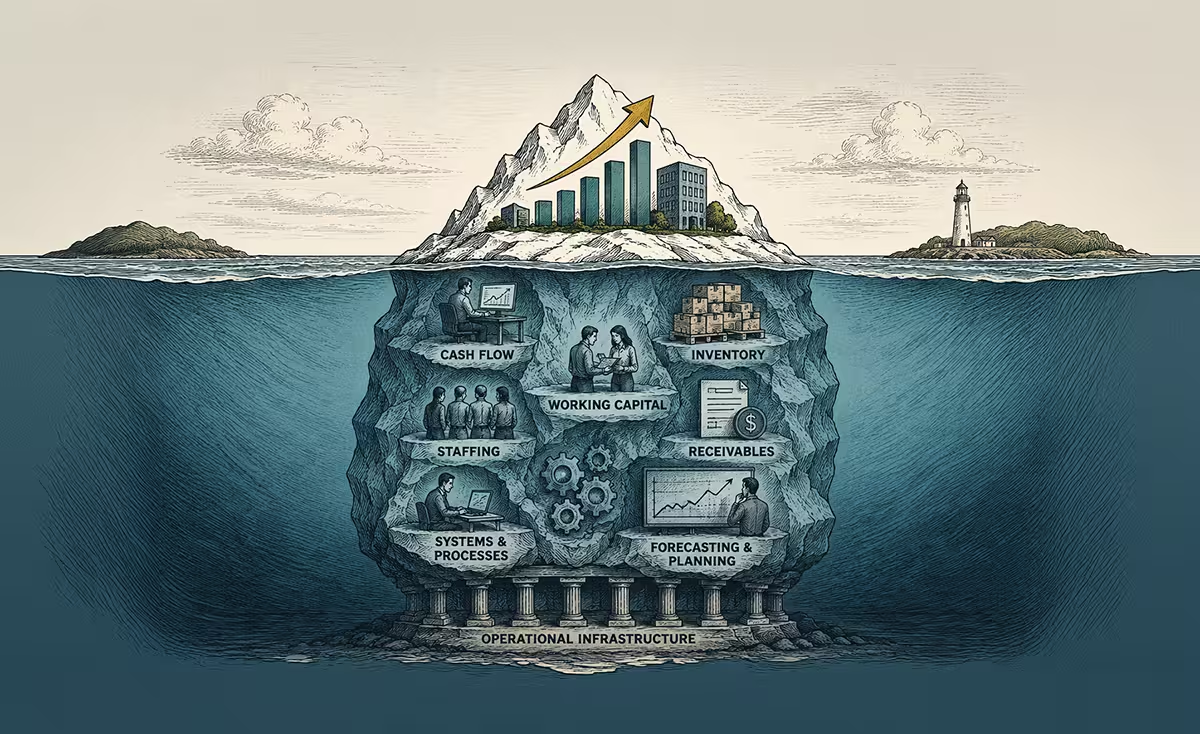
In some cases, growth is exactly what pushes a business into cash flow stress. Not because the business is failing, but because the business is expanding faster than its financial structure can support.
Growth Consumes Cash Before It Creates It
When a business grows, expenses often rise before cash comes back in. More sales may require more inventory. More projects may require more labor. More customers may create more receivables. More capacity may require new equipment, vehicles, systems, or management support.
The income statement may eventually show the benefit of that growth, but the bank account feels the cost first.
Fast-growing businesses often run into trouble because cash goes out before cash comes back in.
Where Growth Consumes Cash
| Growth Requirement | Cash Impact |
|---|---|
| More inventory | Cash is tied up before products are sold or collected. |
| More labor | Payroll increases before customer payments arrive. |
| More receivables | Revenue is recorded, but cash may not be collected for weeks or months. |
| More capacity | Equipment, systems, vehicles, and management infrastructure require upfront investment. |
Growth Magnifies Margin Problems
If a service line is underpriced at $1 million in revenue, growing it to $2 million does not fix the problem. It doubles down on it.
This is where many owners get surprised. The business is busier than ever, but profit does not improve at the same pace. The team feels stretched. Costs rise. Cash gets tight. The owner looks at the revenue growth and wonders why the business does not feel stronger.
Growing low-margin work makes the business larger, not necessarily better.
Before pursuing growth, owners need to understand which services, products, or customer segments are actually creating value. Otherwise, the business may scale the least profitable part of the operation.
Revenue Growth Can Hide Operational Strain
Growth often creates a temporary sense of momentum. The sales pipeline is active. New work is coming in. The business feels successful.
But underneath the surface, the operating model may be getting stretched. Processes that worked at one size may break at the next. Informal management systems become unreliable. Cash flow forecasting becomes more important. Pricing discipline matters more. Hiring mistakes become more expensive.
Common Signs Growth Is Creating Strain
| Warning Sign | What It May Indicate |
|---|---|
| Revenue rising faster than profit | Margins may be compressing or overhead may be growing too quickly. |
| Receivables growing faster than sales | Collections may be slowing as volume increases. |
| Cash balance staying flat despite growth | Working capital may be absorbing the benefit of growth. |
| Owner involvement increasing | Systems, management structure, or reporting may not be scaling. |
The Role of Forecasting
Sustainable growth requires forward-looking financial visibility. Historical reports tell you what happened. Forecasting helps determine what growth will require before the business commits to it.
A useful forecast should show how revenue growth affects cash, staffing, inventory, debt capacity, tax obligations, and profitability. Without that view, owners are making growth decisions without understanding the financial consequences.
Growth should be modeled before it is chased.
Questions a Growth Forecast Should Answer
| Question | Why It Matters |
|---|---|
| How much working capital will growth require? | Growth often needs cash before it produces cash. |
| Will margins hold as volume increases? | Higher volume can expose pricing and cost structure problems. |
| When will new revenue convert to cash? | Timing determines whether growth creates or consumes liquidity. |
| What investments are required to support growth? | Staffing, equipment, systems, and management capacity affect profitability. |
Healthy Growth vs. Risky Growth
Healthy growth improves profitability, strengthens cash flow, and increases business value. Risky growth adds volume without improving the underlying economics.
The difference is visibility. Owners need to know which lines of business are profitable, how quickly cash is collected, whether working capital is adequate, and how growth affects the balance sheet.
Comparing Growth Types
| Healthy Growth | Risky Growth |
|---|---|
| Margins remain stable or improve. | Margins compress as volume increases. |
| Cash flow scales with revenue. | Revenue grows while cash remains tight. |
| Systems and people can support added volume. | The owner and team absorb the strain manually. |
| Growth increases enterprise value. | Growth increases complexity without improving value. |
The Practical Takeaway
Revenue growth is not the goal by itself. Better growth is the goal.
The strongest businesses do not simply chase more sales. They understand which growth is profitable, which growth consumes cash, and which growth makes the company more valuable over time.
The right question is not just how much can we grow. It is what kind of growth makes the business stronger.
For owners navigating growth, the answer starts with financial visibility: clear reporting, accurate forecasting, cash flow analysis, margin review, and a realistic view of the working capital required to support the next stage.
Southcoast Financial Partners works with business owners to build the financial visibility and advisory infrastructure that drives better decisions. Reach out to our team at southcoastfp.com/contact-us.