
Key Points
- The cash conversion cycle measures how long it takes for money invested in your business to come back as cash.
- A business can be profitable and still be perpetually cash-constrained because of a long conversion cycle.
- Three components drive the cycle: how fast you collect, how fast inventory moves, and how long you take to pay vendors.
- Improving any one of the three improves your cash position without changing a dollar of revenue.
- This is one of the first numbers a buyer or lender examines. Most owners have never calculated it.
There is a number that experienced advisors, sophisticated buyers, and smart lenders look at before almost anything else. It does not appear on most financial dashboards. Most business owners have never calculated it. And it explains more about why a profitable business can feel constantly cash-strapped than almost any other metric.
Profit tells you what you earned. The cash conversion cycle tells you how long it takes to actually get it.
Understanding this number, and what drives it, is one of the highest-leverage things a business owner can do. Not because it is complicated, but because improving it generates real cash without requiring more revenue, more customers, or more work.
What the Cash Conversion Cycle Actually Measures
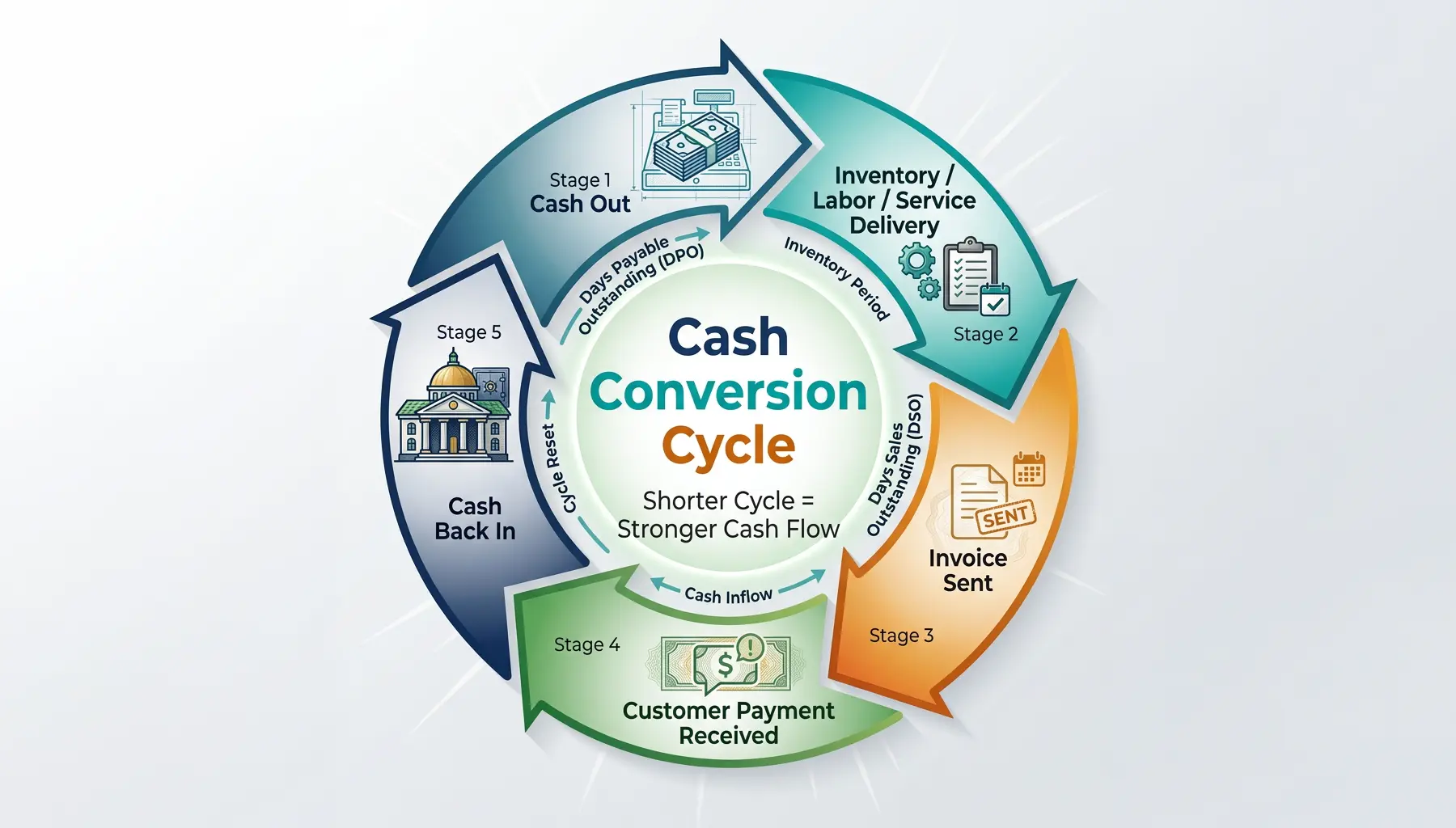
The cash conversion cycle measures the number of days between spending money to run your business and receiving cash back from customers. It captures the full journey: money goes out to fund inventory or deliver a service, work gets done, an invoice gets issued, and eventually, sometimes quickly and sometimes not, cash arrives.
The longer that journey takes, the more working capital the business needs to keep operating. The shorter it is, the less cash gets tied up in the cycle at any given time.
The shorter the cycle, the less cash is trapped inside the day-to-day operations of the business.
The Three Components
| Component | What It Measures | Why It Matters |
|---|---|---|
| Days Sales Outstanding (DSO) | How long customers take to pay invoices | Slow collections tie up cash after work has already been completed |
| Days Inventory Outstanding (DIO) | How long inventory or work-in-progress sits before becoming collectible | Excess inventory or unfinished work creates idle cash |
| Days Payable Outstanding (DPO) | How long the business takes to pay vendors | Better payment terms can help the business hold cash longer |
Days Sales Outstanding (DSO)
Days Sales Outstanding measures how long it takes customers to pay after an invoice is issued. A DSO of 45 means customers are taking 45 days on average to settle their invoices.
A business with $2 million in annual revenue and a 60-day DSO has roughly $330,000 tied up in receivables at any given time. Cutting DSO from 60 to 45 days releases over $80,000 in cash without changing a single other thing about the business.
Days Inventory Outstanding (DIO)
Days Inventory Outstanding measures how long inventory sits before it is sold. For service businesses, this translates to work-in-progress, including time billed but not yet invoiced or projects partially completed but not yet collectible.
Excess inventory is idle cash. High DIO also raises questions about demand forecasting, purchasing discipline, and whether certain product lines are actually moving.
Days Payable Outstanding (DPO)
Days Payable Outstanding measures how long the business takes to pay its own vendors. A higher DPO is generally favorable because it means the business is holding onto cash longer before it goes out the door.
Extending vendor payment terms, where the relationship allows it, is one of the simplest ways to improve the cash conversion cycle without touching revenue or collections at all.
How It All Connects
The cash conversion cycle is simply DSO plus DIO minus DPO. A business collecting in 50 days, holding inventory for 30 days, and paying vendors in 25 days has a cash conversion cycle of 55 days.
Cash Conversion Cycle = DSO + DIO – DPO
| Example Metric | Days |
|---|---|
| Days Sales Outstanding | 50 |
| Days Inventory Outstanding | 30 |
| Days Payable Outstanding | 25 |
| Cash Conversion Cycle | 55 Days |
Every day that number comes down, the business needs less working capital to operate. Every day it goes up, the pressure on cash increases, even if revenue is growing and the income statement looks healthy.
This is why profitable businesses run out of cash. Growth consumes working capital.
If the conversion cycle is long, fast-growing businesses can find themselves funding their own success with debt. Not because the model is broken, but because cash is perpetually tied up in the cycle.
Why Buyers and Lenders Focus Here
A business with a tight, well-managed cash conversion cycle signals operational discipline. Collections are clean. Inventory is managed. Vendor relationships are structured. That discipline translates directly into lower working capital requirements, stronger free cash flow, and a more predictable business to own.
A business with a long or deteriorating cycle raises questions. It may require a working capital adjustment at closing that reduces the seller’s proceeds. It creates uncertainty, and buyers price uncertainty into their offers.
What to Watch For
| Warning Sign | What It May Indicate |
|---|---|
| DSO increasing over time | Customers are paying more slowly and cash is being delayed |
| Inventory days rising | Cash may be tied up in slow-moving inventory or unfinished work |
| DPO shrinking | The business may be paying vendors faster than necessary |
| Cycle lengthening while revenue grows | Growth may be consuming cash faster than it generates it |
A Practical Starting Point
Calculating your cash conversion cycle does not require a complex model. It requires three numbers from your financials and about ten minutes with your advisor.
Once you have the number, the conversation shifts from abstract to specific. Which component is driving the cycle? Where is the most realistic opportunity to improve it? What would a 15-day improvement be worth in freed-up cash?
Southcoast Financial Partners works with business owners to build the financial visibility and advisory infrastructure that drives better decisions. Reach out to our team at southcoastfp.com/contact-us.