
The lowest-priced supplier is not always the lowest-cost option.
For manufacturers, a sourcing decision can affect much more than the price paid for a component.
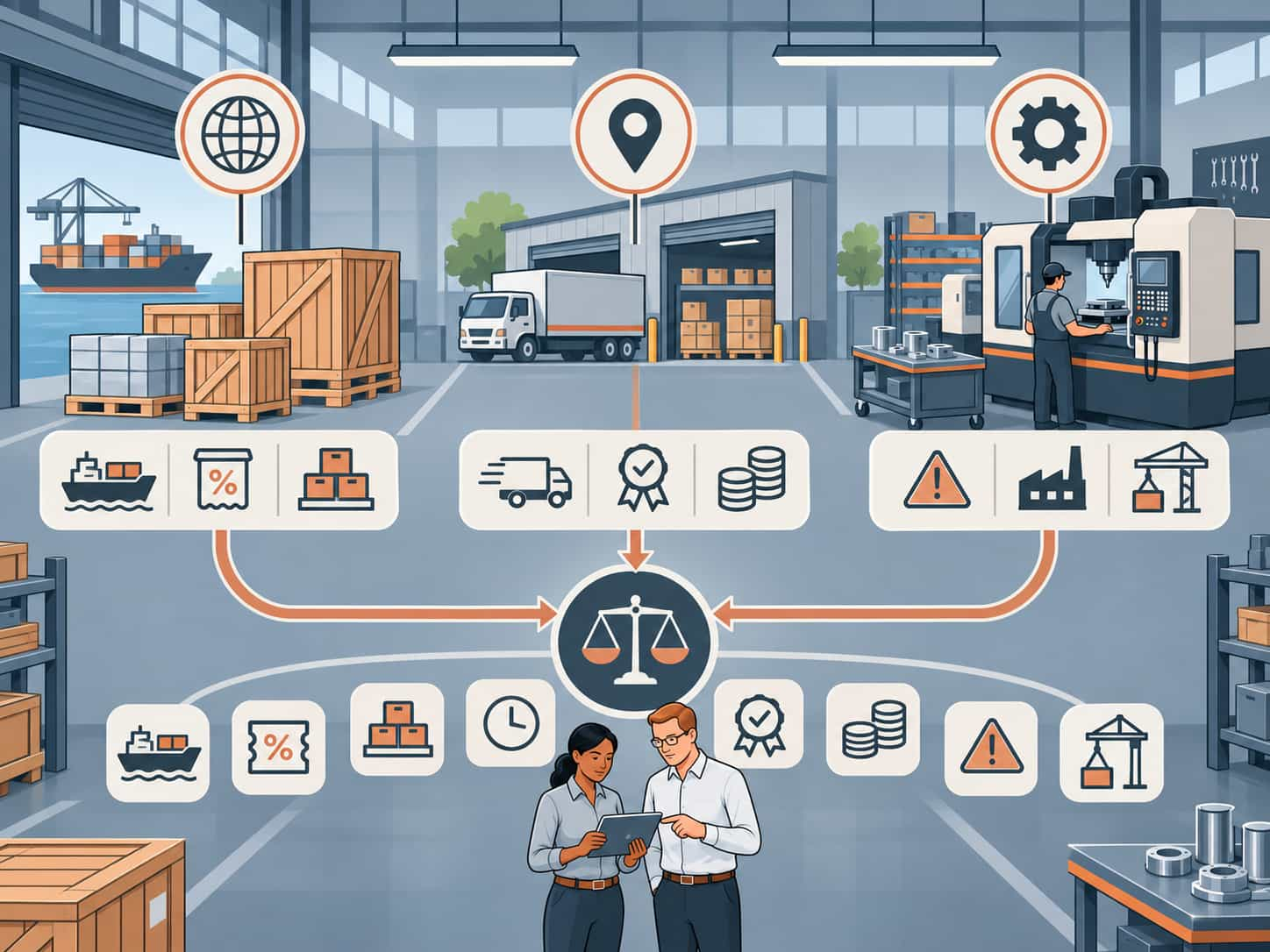
Freight, tariffs, lead times, inventory requirements, supplier reliability, quality, working capital, production interruptions, and customer commitments can all change the economics of the decision.
Bringing production in-house introduces a different set of considerations: equipment, labor, floor space, training, maintenance, financing, and additional management responsibility.
That is why a make-or-buy decision should not begin and end with a comparison of unit costs.
The better question is: which sourcing strategy creates the strongest economic outcome for the business when cost, cash flow, risk, and long-term strategy are considered together?
- Unit price is only one part of the true cost of a sourcing decision.
- Freight, tariffs, inventory, quality, lead times, and supplier risk can materially change the economics.
- Bringing production in-house may improve control, but it also creates capital, labor, and working-capital requirements.
- Manufacturers should compare sourcing alternatives under multiple operating scenarios.
- The strongest decisions connect operations with cash flow, forecasting, tax planning, capital allocation, and long-term strategy.
Start With Total Cost, Not Unit Cost
Purchasing teams naturally pay attention to the price quoted by a supplier.
But a $22 component from one source is not necessarily cheaper than a $26 component from another.
The first supplier may require larger minimum orders, longer transportation times, higher freight costs, additional inventory, customs expenses, more quality inspection, or a larger safety stock.
The second supplier may cost more per unit but provide shorter lead times, smaller order quantities, more predictable delivery, and less cash tied up in inventory.
The correct comparison is not simply $22 versus $26.
It is the total economic cost of each alternative.
NIST has encouraged manufacturers to use a total cost of ownership approach when evaluating sourcing decisions, specifically recognizing that freight, tariffs, time, and other supply-chain costs can materially change the economics beyond the purchase price. Read the NIST guidance.
What Does the Supplier Really Cost?
For an externally sourced part or component, management should consider all of the costs required to get that part into production.
That may include:
- purchase price
- freight and transportation
- tariffs and duties
- brokerage or customs costs
- inspection and quality control
- scrap and rework
- expedited shipping
- safety stock
- warehouse space
- insurance
- currency exposure
- supplier management
- production delays
Some of these costs appear directly on the income statement.
Others are less obvious.
A long lead time, for example, may force the company to maintain additional inventory. That inventory consumes cash and increases exposure to excess or obsolete stock.
A supplier with inconsistent quality may create additional labor, scrap, downtime, or customer service costs.
A supplier disruption may force emergency purchasing or expedited freight at exactly the wrong time.
Those costs belong in the sourcing analysis even if they never appear on the supplier invoice.
Working Capital Can Change the Answer
Two sourcing strategies can have similar gross margins and very different cash-flow requirements.
Consider an overseas supplier requiring a 12-week lead time and large minimum order quantities.
The manufacturer may need to purchase substantially more inventory in advance and carry that material for months before it becomes a finished product and ultimately a customer payment.
A domestic supplier with a higher purchase price but a shorter replenishment cycle may allow the company to operate with significantly less inventory.
That difference matters because inventory is not just an operating metric. It is cash invested in the business.
Manufacturers should therefore consider the effect of each sourcing alternative on inventory days, cash conversion cycle, and overall working capital requirements.
A sourcing decision that appears slightly more expensive on a per-unit basis may still produce a stronger cash-flow outcome.
What Would It Take to Bring Production In-House?
Once the true cost of outsourcing is understood, manufacturers can compare it with the economics of producing the component internally.
But internal production also needs to be evaluated realistically.
The cost is not simply raw material plus direct labor.
Bringing production in-house may require:
- new machinery or automation
- tooling and fixtures
- additional employees
- training
- engineering support
- floor space
- utilities
- maintenance
- quality systems
- software or technology integration
- additional inventory
- management oversight
The company also needs to determine whether it has enough volume to support those fixed costs.
A process may be cheaper internally at 200,000 units per year and more expensive at 50,000.
That makes expected production volume one of the most important assumptions in a make-or-buy analysis.
If bringing the work in-house requires a significant equipment purchase, the analysis should also connect with the capital-investment framework discussed in Should You Buy the Machine?.
Reshoring Is a Financial Decision, Not a Slogan
For some manufacturers, the decision may not be limited to making a component internally or continuing with the current supplier.
A third option may be moving the supply closer to home.
That could mean shifting from an overseas supplier to a domestic supplier, nearshoring to a closer market, or bringing production into the company's own facility.
The case for reshoring should still be evaluated financially.
NIST's 2026 report on the U.S. manufacturing economy identifies supply-chain resilience, proximity between manufacturing and engineering, freight and duty costs, geopolitical risk, proximity to customers, and quality among the reasons manufacturers consider reshoring. View the NIST report.
Those benefits can be significant, but they do not eliminate the costs of domestic labor, capital investment, automation, facilities, or implementation.
The goal should not be to reshore because reshoring sounds attractive.
The goal should be to understand whether a different sourcing structure creates a stronger and more resilient business.
How Much Is Supply-Chain Risk Worth?
Risk is one of the hardest factors to incorporate into a financial model because it does not always produce a predictable monthly expense.
Until something goes wrong.
A critical component arriving late can idle production.
A quality failure can require rework or delay a shipment.
A supplier experiencing financial difficulty can create an urgent need to find an alternative.
A transportation disruption can force expensive expedited shipping.
For a manufacturer serving customers with strict delivery commitments, the financial consequences may extend well beyond the cost of the missing part.
Management should consider both the probability and potential financial impact of those disruptions.
Questions might include:
- What would one day of production downtime cost?
- How long would it take to qualify an alternative supplier?
- Is the company dependent on one supplier for a critical component?
- Could a disruption cause the company to miss a customer delivery?
- Would additional safety stock be required to protect the operation?
There may not be a perfect number for every risk.
But leaving risk out of the analysis entirely effectively assumes that the cost is zero.
That can be an expensive assumption.
Tariffs Can Change the Economics Quickly
Tariffs and trade policy have become another variable manufacturers need to incorporate into sourcing decisions.
The important issue for management is not predicting what trade policy will look like several years from now.
It is understanding how sensitive the business is to changes in those costs.
If an imported component becomes 10% more expensive, what happens to the product margin?
Can some or all of that increase be passed to the customer?
Would a domestic supplier become competitive?
Would the economics support internal production?
How much additional cash would be required to support the change?
KPMG's 2026 tariff research found businesses increasingly reconsidering supply chains and reshoring strategies as tariff and cost pressures altered traditional sourcing economics. Review the KPMG findings.
The practical response is scenario planning.
Rather than build one sourcing model around today's cost structure, manufacturers can evaluate how the decision changes under several realistic cost assumptions.
Compare the Alternatives Side by Side
A sourcing decision becomes clearer when leadership can compare the major alternatives using the same assumptions.
| Consideration | Current Supplier | Domestic Supplier | Make In-House |
|---|---|---|---|
| Unit Cost | Supplier quote | Supplier quote | Material + production cost |
| Freight / Tariffs | Potentially higher | Potentially lower | Depends on material sourcing |
| Inventory | Based on lead time and MOQ | Potentially lower | Raw material + WIP |
| Capital Required | Limited | Limited | Potentially significant |
| Lead Time | Supplier dependent | Potentially shorter | Production dependent |
| Control | Lower | Moderate | Higher |
| Operational Risk | Supplier and logistics risk | Supplier risk | Capacity and execution risk |
The objective is not to make every category perfectly quantifiable.
It is to create a common financial framework so ownership can see the tradeoffs clearly.
Run the Decision Through More Than One Scenario
A sourcing model based on one forecast can create false confidence.
Volume changes. Material costs move. Supplier pricing changes. Customer demand shifts. Equipment takes longer to implement than expected.
Manufacturers should test the sourcing decision under several realistic scenarios.
Base Case: Expected volume, current pricing, normal lead times, and realistic utilization.
Upside Case: Stronger demand, higher utilization, or greater savings from internal production.
Downside Case: Lower volume, higher labor or material costs, implementation delays, supplier disruption, or weaker customer demand.
The downside case can be particularly revealing when internal production requires significant capital.
A sourcing strategy that works only when every assumption goes right may deserve additional scrutiny.
This is another reason manufacturers benefit from an active forecasting process rather than relying solely on an annual budget.
Some Benefits Are Strategic, Not Just Financial
Not every consideration will fit neatly into a spreadsheet.
Bringing a process closer to the business may improve communication between engineering and production.
Shorter lead times may make the company more responsive to customers.
Internal production may provide greater control over quality or intellectual property.
A domestic supplier may provide greater flexibility during a disruption.
Those benefits still matter.
The challenge is distinguishing genuine strategic value from assumptions that simply make a preferred decision look more attractive.
Leadership should be able to explain what strategic advantage is expected and why that advantage is important to the company's customers, economics, or competitive position.
This Is Where Integrated Financial Thinking Matters
A sourcing decision may begin in purchasing or operations, but it rarely stays there.
Changing suppliers can affect inventory and working capital.
Bringing production in-house can require equipment and financing.
Additional equipment can affect tax planning and depreciation.
New employees affect labor costs and capacity.
A different production footprint can change margins, forecasts, and customer profitability.
Each decision creates consequences somewhere else in the business.
That is why Southcoast Financial Partners believes significant operating decisions should be evaluated through the broader financial picture rather than one department or one metric at a time.
Accounting, forecasting, cash flow, tax planning, capital investment, and business strategy should be working from the same decision.
This is the same integrated approach we discuss in Integrated Financial Leadership for Growing Manufacturers.
Good financial thinking does not replace the operating team's judgment.
It gives ownership a clearer understanding of the economic consequences of the choices the operating team is considering.
The Cheapest Option Is Not Always the Best Option
Make, buy, and reshoring decisions rarely have one obvious answer.
A lower supplier price may come with higher inventory and greater risk.
A domestic supplier may cost more but improve responsiveness and reduce cash tied up in the supply chain.
Internal production may create greater control and stronger margins at sufficient volume, but require substantial capital and operating discipline.
The right answer depends on the economics of the individual business.
The goal is not to choose the lowest-cost line item. It is to choose the sourcing strategy that creates the strongest overall financial and strategic outcome.
If your manufacturing business is evaluating a significant sourcing, reshoring, or make-or-buy decision, contact Southcoast Financial Partners to discuss how financial modeling, forecasting, working-capital analysis, and integrated planning can help you evaluate the options.